Stories usually have the following things:
1. An exposition (sets the scene, introduces the characters)
2. An inciting incident (something happens to get the ball rolling)
3. A development (things get more complicated)
4. A secondary plot line or a new character who comes into the story.
5. A climax (a dramatic scene where some of the problems are reverse or resolved)
6. A resolution (some other things get resolved to wind the story down - there might be a twist here)
7. An ending (it could have twist too)
A story needs to hold something back from the reader. For example there might be a vital piece of information the reader or view doesn't find out until later.
Read these story sketches and think about how they could be developed or rewritten.
The Campfire
Long ago in a run-down cave, two cavemen, Uu and Aa, were sitting next to a campfire to hide from the cold winter wind outside. Uu wasn't feeling so good as he had eaten a rotten dodo the day before. As he turned away from the campfire to get some tea he said "uuuu" and farted into the flames. There was a large explosion as the fart caught fire. Aa immediately ran out of the cave yelling "aaaa!".
Meanwhile a man dressed in a suit, the manager of a nearby theme park, was sitting in his office. At the moment of Uu's fart, he felt an earthquake and saw the park's ferris wheel wobble. Suddenly, it began to topple and then fell flat on the ground below, crushing scores of people. Immediately a fire broke out. Then Renzo woke up, glad that it was all merely a dream.
Aladdin in Ancient Egypt
Once upon a time in Ancient Egypt, Cleopatra was lying in bed, patting her cat Sir Toby. It was early in the morning. Suddenly Sir Toby began to choke. Cleopatra called her servant: "Quick! Sir Toby is dying!". However, no one came to help her. The Egyptian queen went into a panic. She didn't know what to do!
Meanwhile in another part of the city, Aladdin was smoking pot and watching morning TV - Teletubbies - as was usual for him on Tuesdays. Suddenly Cleopatra's cries for assistance came through the TV set. According to ancient historians, Cleopatra was actually quite ugly, but had a most beautiful, charming voice. And so Aladdin became enchanted and hopped straight onto his magic carpet.
The Ballad of Juan-Carlos
It was during a long freezing winter in a bar called Seven Steps to Heaven, and it was one of those nights peaceful nights when the crowd gets wild and crazy on heavy metal. So everything was pretty mundane.
Suddenly, a big shadow appeared at the threshold of the club. No one could see who it was, but no sooner had the dark shadow stepped into the light than the entire bar was on fire: Bikini Babes started to fly around, flowers began to sing, dolls passed out and donkeys danced the Macarena. For Juan-Carlos, the most famous teddy bear of the century had arrived. Juan-Carlos was wearing only underwear, revealing his breathtaking abs.
But while everyone was admiring him, there was one person who didn't seem impressed. It was a German radio active flower called Radio-Active Flower.
Flower approached Juan-Carlos and said: "Ich bin eine flower, ich know di bist ein porn star in the past! So pay me in alcohol recht now! Or ich will publish dis porn video of du on the 15 TV screens in dis bar!"
Juan-Carlos answered: "Fiend! I have no choice but to bow to your wicked will! Bartender! A create the your best champagne for the senorita!"
But as Radioactive Flower was a true criminal, she published the videos anyway!
Now the whole bar became a scene of diabolical destruction and mayhem. There was blood, chairs flew through the air, glasses were smashed onto heads, needs were driven into eyeballs. Juan-Carlos had his legs and arms torn off by Bikini Babes.
Suddenly a meteorite crashed into the bar, killing everyone.
Sunday, September 1, 2019

C1.2 Unit 6 Project
Create a live story - work in small groups
1. IDEA. Think up an idea as a team.
2. CHARACTERS. Develop your characters a little. Remember the number one rule of comedy: find the flaw and play it up. In other words, exaggeration is OK.
3. PLOT. Develop the plot a little. Remember the basic pyramid shape of a story: exposition, development, climax, resolution. Can there be some "buts", "sos" and "meanwhiles" (different threads) to make the story more complex? Can you introduce a new character at some point?
4. TWIST. Does your story have a good one? Can you add anything into the story that will make the twist funnier or more dramatic?
5. TWEAKING. Once you have your basic story and characters, go over it and tweak it, adding some little surprises and details to make it as entertaining as possible.
6. OPTIONS. Look for some IMAGES you can use as a backdrop of your story. Can they communicate locations or emotions in a dramatic or humorous way? Add MUSIC or sounds to your story too, but don't make it too technical. You could also use PROPS or COSTUMES if they add humour or interest.
8. REHEARSE.
9. PERFORM.
1. IDEA. Think up an idea as a team.
2. CHARACTERS. Develop your characters a little. Remember the number one rule of comedy: find the flaw and play it up. In other words, exaggeration is OK.
3. PLOT. Develop the plot a little. Remember the basic pyramid shape of a story: exposition, development, climax, resolution. Can there be some "buts", "sos" and "meanwhiles" (different threads) to make the story more complex? Can you introduce a new character at some point?
4. TWIST. Does your story have a good one? Can you add anything into the story that will make the twist funnier or more dramatic?
5. TWEAKING. Once you have your basic story and characters, go over it and tweak it, adding some little surprises and details to make it as entertaining as possible.
6. OPTIONS. Look for some IMAGES you can use as a backdrop of your story. Can they communicate locations or emotions in a dramatic or humorous way? Add MUSIC or sounds to your story too, but don't make it too technical. You could also use PROPS or COSTUMES if they add humour or interest.
8. REHEARSE.
9. PERFORM.
(Advanced) Elements of Surprise: Our Mental Limits and the Satisfactions of Plot

Vera Tobin is a professor in cognitive linguistics and is fascinated by our fascination with unexpected plot twists. She reveals what's going on in our brains when stories take us in unexpected directions in her book, Elements of Surprise: Our Mental Limits and the Satisfactions of Plot.
Elements of surprise
Listen from 4:30 - 7:20
Why are we "on safe ground" talking about the film Sixth Sense?
What is the twist in Sixth Sense?
What happens at the beginning of Sixth Sense?
What does Vera mean by "wiggle room"?
Listen from 7:20 - 8:50
Listen and then try writing out what Vera has said here about the two things that make a plot twist gratifying?
One thing is that doesn't just but .
The other thing is that not that but that
Listen from 11:00 - 1315
Once you know the answer and you look back, ___ ____ ____ ______ it in a new light, ____ you say it ____ seems so obvious.
The basketball video.
Listen from 13:15 - 16:45
Besides the plot twist, what is the other kind of twist?
Why are Sherlock Holmes stories sometimes "a bit of a shell game"?
Listen from 18:10 - 19:57
What two things does The Good Place do differently from other shows?
1.
2.
Television can sometimes be ____ more beguiling and surprising to ____ ___ ___ who watch it with an analytical ____.
Sunday, August 25, 2019
Good Morning Vietnam - Cursing Class
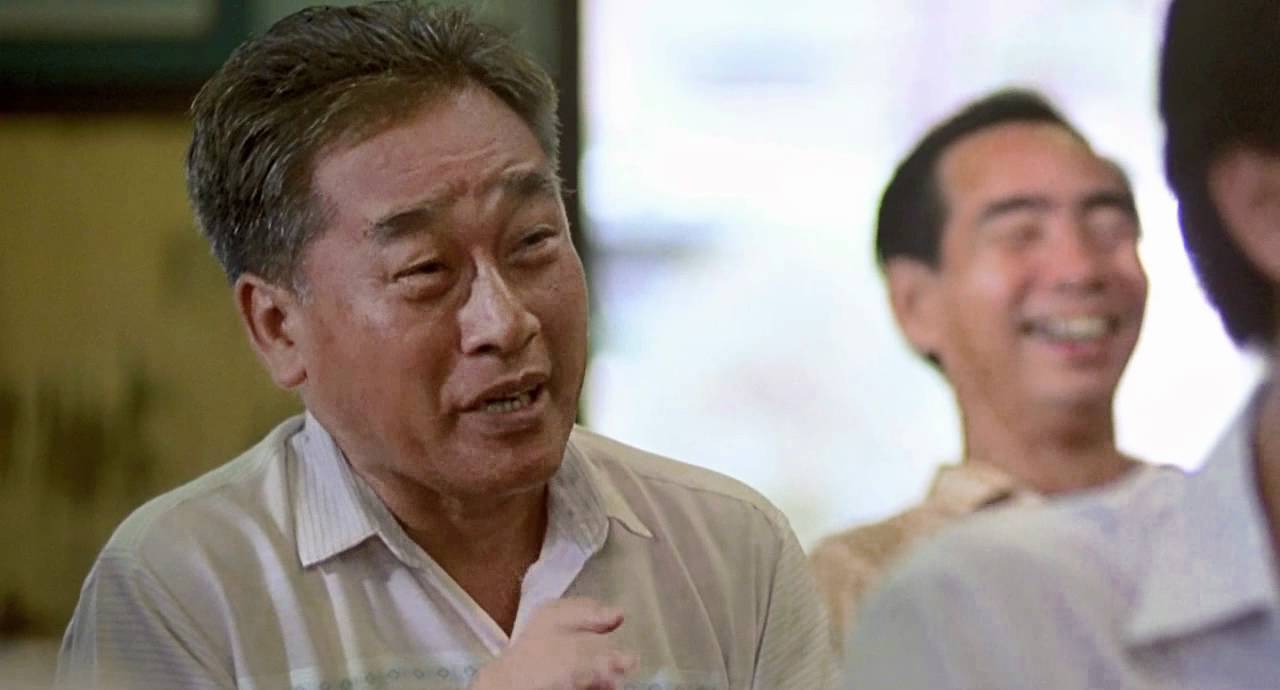
Good Morning Vietnam
Why do you think the teacher is focussing on "bad" language?
If someone is not telling the truth, you say they are full of _____
If someone is making you angrier and angrier, therefor you have ______ ___ ____
If someone cuts you off when driving, all of a sudden you, ____ them the ____
What happens when the woman says "crap"?
(Advanced) Shakespeare

William Shakespeare 1564 – 1616
1. What does David believe makes Shakespeare so relevant today?
2. What are some of the phrases of Shakespeare mentioned?
3. What might have been the motivation for the author of Shakespeare's plays to hide their identity? (what does the adjective "lowly" mean?)
4. Why does David feel the conspiracy theories are snobbish?
5. What kind of accent does David have? (what does "common as muck" mean?)
6. Who was the special guest at the commemoration of Shakespeare's death?
7. What "tower" was David's final joke referring to?
The playwrights of the theatre echoed the slang of these areas. Shakespeare combined the language of the courtiers with the language of the street.
There were no props or scenery so language was the primary means of conveying the scene.
The theatres attracted enormous crowds.
1 in 2 Londoners would see a successful Shakespeare play.
Arguably, no other artist has influenced how we both use and conceive of English today more than Shakespeare. Certainly no other writer, or any English speaking artist, has the status of Shakespeare. His language language has disseminated throughout the language:
Over 2000 words derive from his works. Words which broaden our understanding of ourselves. He didn't always invent them, but he used them in a way that gave them currency in the language.
Obscene
Advertising
Courtship
Reliance
Eventful
Shakespeare’s vocabulary was huge.
Then there are the many quotable phrases he coined. Any reasonably educated native speaker of English will quote Shakespeare, often without realising it:
To be or not to be
To thine own self be true
As good luck would have it
In my mind’s eye
To be cruel to be kind
To hold the mirror up to nature
Make a virtue of necessity
Watch:
0:00 - 1:00
"It's _____ to me."
"More s_____ against than s______"
"S____ days"
To act "more in s____ than in a____"
"Your ____ is father to the th____"
"________ into thin air"
To refuse to "____ an inch"
"____-eyed jealousy"
To "play ___ and loose"
"tongue-____"
"a tower of _____"
"hood_____ed"
"__ a pickle"
to "k___ your brows"
to "make a v_____ of necessity"
to insist on "f___ play"
Sleep "___ one wink"
to "stand on c_______y"
to "dance attendance to your lord and m______"
to "_____ yourself into stitches"
to "have sh____ shrift"
"___ comfort"
"___ much of a good thing"
"seen _____ days"
"___'s paradise"
"be that as it ___"
"the __ fool you"
a "foregone c_____"
"as ___ ___ would have it"
Shakespeare was not a courtier. He was born and educated in Stratford. A middle class boy. He had a Stratford accent - in other words a country rather than a city accent. He picked up French and Italian late. He didn’t go to university
Like the writer of Beowulf, Shakespeare loved compound words – often ones that were unique to him:
Baby-eyes
Fair play
Half-blown
Ill-tuned
Being a Stratford boy, he used many regional words too.
Writers (and their audiences) were in some ways much freer with language than we are. They could pronounce the same word differently for instance. ComPLETE or COMplete.
Writers (and their audiences) were in some ways much freer with language than we are. They could pronounce the same word differently for instance. ComPLETE or COMplete.
Shakespeare combined monosyllables with multi-syllables. The power of his plays comes from the interplay of the high and low words.
He loved insults. Notice how these play monosyllables off against multi-syllabic or multi-word phrases words. Of high register and grammatical form against low.
“Thou art like a toad; ugly and venomous.”
“Thou art a flesh-monger, a fool and a coward.”
“A most notable coward, an infinite and endless liar, an hourly promise breaker, the owner of no one good quality.”
“You scullion! You rampallian! You fustilarian! I’ll tickle your catastrophe!”
“Methink’st thou art a general offence and every man should beat thee.”
“Thou art as loathsome as a toad.”
“Thou clay-brained guts, thou knotty-pated fool, thou whoreson obscene greasy tallow-catch!”
Shakespeare and rhetoric
What is rhetoric?
"the faculty of discovering the possible means of persuasion in reference to any subject whatever.”
-Aristotle

The rules of rhetoric were second nature to the great phrase-makers. Shakespeare knew them well.
Author Mark Forsyth says:
Author Mark Forsyth says:
“If you think genius is some kind of magical thing, lightning that hits you from heaven, it’s not that. Shakespeare was a guy who learned all the skills, the rules, the formulas and the figures of rhetoric and then he deployed them better than anyone else has ever deployed them."
Listen from 7:40 to 9:07
AABA
Some terms to describe rhetorical formulas:
Alliteration: repetition of the same sound beginning several words in sequence.
*Let us go forth to lead the land we love. J. F. Kennedy, Inaugural
Anaphora: the repetition of a word or phrase at the beginning of successive phrases, clauses or lines.
*We shall not flag or fail. We shall go on to the end. We shall fight in France, we shall fight on the seas and oceans, we shall fight with growing confidence and growing strength in the air, we shall defend our island, whatever the cost may be, we shall fight on the beaches, we shall fight on the landing grounds, we shall fight in the fields and in the streets, we shall fight in the hills. We shall never surrender. Churchill.
Antithesis: opposition, or contrast of ideas or words in a balanced or parallel construction.
*Brutus: Not that I loved Caesar less, but that I loved Rome more. Shakespeare, Julius Caesar
Assonance: repetition of the same sound in words close to each other.
*Thy kingdom come, thy will be done.
Chiasmus: two corresponding pairs arranged not in parallels (a-b-a-b) but in inverted order (a-b-b-a); from shape of the Greek letter chi (X).
*...ask not what your country can do for you, ask what you can do for your country. John F. Kennedy
Metaphor: implied comparison achieved through a figurative use of words; the word is used not in its literal sense, but in one analogous to it.
*Life's but a walking shadow; a poor player,
That struts and frets his hour upon the stage. Shakespeare, Macbeth
Metonymy: substitution of one word for another which it suggests.
*He is a man of the cloth.
Oxymoron: apparent paradox achieved by the juxtaposition of words which seem to contradict one another.
*I must be cruel only to be kind. Shakespeare, Hamlet
Paradox: an assertion seemingly opposed to common sense, but that may yet have some truth in it.
*What a pity that youth must be wasted on the young. George Bernard Shaw
Simile: an explicit comparison between two things using 'like' or 'as'.
*Reason is to faith as the eye to the telescope. D. Hume [?]
Tautology: repetition of an idea in a different word, phrase, or sentence.
*With malice toward none, with charity for all. Lincoln, Second Inaugural
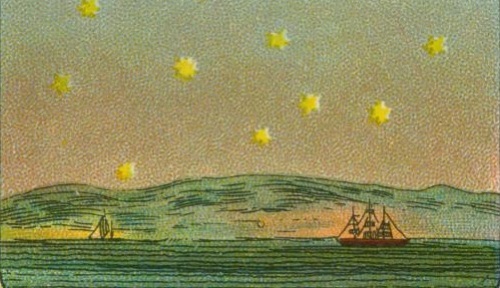
Sonnet 116: Let me not to the marriage of true minds
Related Poem Content Details
Let me not to the marriage of true minds
Admit impediments. Love is not love
Which alters when it alteration finds,
Or bends with the remover to remove.
O no! it is an ever-fixed mark
That looks on tempests and is never shaken;
It is the star to every wand'ring bark,
Whose worth's unknown, although his height be taken.
Love's not Time's fool, though rosy lips and cheeks
Within his bending sickle's compass come;
Love alters not with his brief hours and weeks,
But bears it out even to the edge of doom.
If this be error and upon me prov'd,
I never writ, nor no man ever lov'd.
Sonnet 116
Read in a Stratford accent:
Sonnet 116
Read in a Stratford accent:
Sonnet 116
"The eminent Shakespearean scholar John Barton has suggested that Shakespeare's accent would have sounded to modern ears like a cross between a contemporary Irish, Yorkshire and West Country accent.
Others say that the speech of Elizabethans was much quicker than it is in modern-day Shakespeare productions."
Task:
1. Divide the poem into 3 stanzas and a couplet.
2. Work out the metre and rhyme scheme.
3. Do the next two poems have the same format?

Sonnet 12: When I do count the clock that tells the time
Related Poem Content Details
When I do count the clock that tells the time,
And see the brave day sunk in hideous night;
When I behold the violet past prime,
And sable curls all silver’d o’er with white;
When lofty trees I see barren of leaves
Which erst from heat did canopy the herd,
And summer’s green all girded up in sheaves
Borne on the bier with white and bristly beard,
Then of thy beauty do I question make,
That thou among the wastes of time must go,
Since sweets and beauties do themselves forsake
And die as fast as they see others grow;
And nothing ‘gainst Time’s scythe can make defence
Save breed, to brave him when he takes thee hence.
Notice the repetition "when" and "and" - notice how the word "save" means "except" here and that it is also an exceptional word in the poem's structure.
Something I like about this poem is the way it blurs the lines between self and other in order to sow doubt. Everything is allowed a degree of will: time, trees, beauty. But all also cannot escape their limitations. Even time can't prevent nature from defying oblivion.
Sonnet 12
quizlet quiz
Notice the repetition "when" and "and" - notice how the word "save" means "except" here and that it is also an exceptional word in the poem's structure.
Something I like about this poem is the way it blurs the lines between self and other in order to sow doubt. Everything is allowed a degree of will: time, trees, beauty. But all also cannot escape their limitations. Even time can't prevent nature from defying oblivion.
Sonnet 12
quizlet quiz
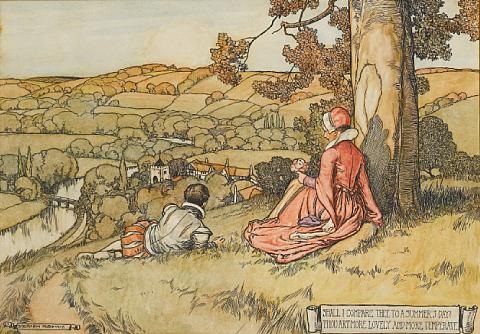
Sonnet 18: Shall I compare thee to a summer’s day?
Related Poem Content Details
Shall I compare thee to a summer’s day?
Thou art more lovely and more temperate:
Rough winds do shake the darling buds of May,
And summer’s lease hath all too short a date;
Sometime too hot the eye of heaven shines,
And often is his gold complexion dimm'd;
And every fair from fair sometime declines,
By chance or nature’s changing course untrimm'd;
But thy eternal summer shall not fade,
Nor lose possession of that fair thou ow’st;
Nor shall death brag thou wander’st in his shade,
When in eternal lines to time thou grow’st:
So long as men can breathe or eyes can see,
So long lives this, and this gives life to thee.
Shakespeare tends to use very basic grammatical words as the hinges in his sonnets. Can you remember / guess the missing words in these lines (note how often the first word of a line is a conjunction or other grammatical word).
____ I compare thee to a summer’s day?
____ art more lovely and more temperate:
Rough winds ___ shake the darling buds of May,
___ summer’s lease hath all too short a date;
______ too hot the eye of heaven shines,
And ____ is his gold complexion dimm'd;
And every fair ____ fair sometime declines,
___ chance or nature’s changing course untrimm'd;
___ thy eternal summer shall not fade,
___ lose possession of that fair thou ow’st;
___ shall death brag thou wander’st in his shade,
___ in eternal lines to time thou grow’st:
___ long as men can breathe or eyes can see,
___ long lives this, ___ this gives life to thee.
Notice the same thing here in Sonnet 73
Notice the same thing here in Sonnet 73
Sonnet 73: That time of year thou mayst in me behold
Related Poem Content Details
That time of year thou mayst in me behold
When yellow leaves, or none, or few, do hang
Upon those boughs which shake against the cold,
Bare ruin'd choirs, where late the sweet birds sang.
In me thou see'st the twilight of such day
As after sunset fadeth in the west,
Which by and by black night doth take away,
Death's second self, that seals up all in rest.
In me thou see'st the glowing of such fire
That on the ashes of his youth doth lie,
As the death-bed whereon it must expire,
Consum'd with that which it was nourish'd by.
This thou perceiv'st, which makes thy love more strong,
To love that well which thou must leave ere long.
Sonnet 73 sung by Paul Kelly
that time of year (1): i.e., being late autumn or early winter.
When yellow leaves... (2): compare Macbeth (5.3.23) "my way of life/is fall'n into the sere, the yellow leaf."
Bare ruin'd choirs (4): a reference to the remains of a church or, more specifically, a chancel, stripped of its roof and exposed to the elements. The choirs formerly rang with the sounds of 'sweet birds'. Some argue that lines 3 and 4 should be read without pause -- the 'yellow leaves' shake against the 'cold/Bare ruin'd choirs.' If we assume the adjective 'cold' modifies 'Bare ruin'd choirs', then the image becomes more concrete -- those boughs are sweeping against the ruins of the church. Some editors, however, choose to insert 'like' into the opening of line 4, thus changing the passage to mean 'the boughs of the yellow leaves shake against the cold like the jagged arches of the choir stand exposed to the cold.' Noted 18th-century scholar George Steevens commented that this image "was probably suggested to Shakespeare by our desolated monasteries. The resemblance between the vaulting of a Gothic isle [sic] and an avenue of trees whose upper branches meet and form an arch overhead, is too striking not to be acknowledged. When the roof of the one is shattered, and the boughs of the other leafless, the comparison becomes more solemn and picturesque" (Quoted in Smith, p. 148).
black night (7): a metaphor for death itself. As 'black night' closes in around the remaining light of the day, so too does death close in around the poet.
Death's second self (8): i.e. 'black night' or 'sleep.' Macbeth refers to sleep as "The death of each day's life" (2.2.49).
In me thou see'st...was nourish'd by (9-12): The following is a brilliant paraphrase by early 20th-century scholar Kellner: "As the fire goes out when the wood which has been feeding it is consumed, so is life extinguished when the strength of youth is past." (Quoted in Rollins, p. 191)
that (12): i.e., the poet's desires.
This (14): i.e., the demise of the poet's youth and passion.
To love that well (12): The meaning of this phrase and of the concluding couplet has caused much debate. Is the poet saying that the young man now understands that he will lose his own youth and passion, after listening to the lamentations in the three preceding quatrains? Or is the poet saying that the young man now is aware of the poet's imminent demise, and this knowledge makes the young man's love for the poet stronger because he might soon lose him? What must the young man give up before long -- his youth or his friend? For more on this dilemma please see the commentary below.
that time of year (1): i.e., being late autumn or early winter.
When yellow leaves... (2): compare Macbeth (5.3.23) "my way of life/is fall'n into the sere, the yellow leaf."
Bare ruin'd choirs (4): a reference to the remains of a church or, more specifically, a chancel, stripped of its roof and exposed to the elements. The choirs formerly rang with the sounds of 'sweet birds'. Some argue that lines 3 and 4 should be read without pause -- the 'yellow leaves' shake against the 'cold/Bare ruin'd choirs.' If we assume the adjective 'cold' modifies 'Bare ruin'd choirs', then the image becomes more concrete -- those boughs are sweeping against the ruins of the church. Some editors, however, choose to insert 'like' into the opening of line 4, thus changing the passage to mean 'the boughs of the yellow leaves shake against the cold like the jagged arches of the choir stand exposed to the cold.' Noted 18th-century scholar George Steevens commented that this image "was probably suggested to Shakespeare by our desolated monasteries. The resemblance between the vaulting of a Gothic isle [sic] and an avenue of trees whose upper branches meet and form an arch overhead, is too striking not to be acknowledged. When the roof of the one is shattered, and the boughs of the other leafless, the comparison becomes more solemn and picturesque" (Quoted in Smith, p. 148).
black night (7): a metaphor for death itself. As 'black night' closes in around the remaining light of the day, so too does death close in around the poet.
Death's second self (8): i.e. 'black night' or 'sleep.' Macbeth refers to sleep as "The death of each day's life" (2.2.49).
In me thou see'st...was nourish'd by (9-12): The following is a brilliant paraphrase by early 20th-century scholar Kellner: "As the fire goes out when the wood which has been feeding it is consumed, so is life extinguished when the strength of youth is past." (Quoted in Rollins, p. 191)
that (12): i.e., the poet's desires.
This (14): i.e., the demise of the poet's youth and passion.
To love that well (12): The meaning of this phrase and of the concluding couplet has caused much debate. Is the poet saying that the young man now understands that he will lose his own youth and passion, after listening to the lamentations in the three preceding quatrains? Or is the poet saying that the young man now is aware of the poet's imminent demise, and this knowledge makes the young man's love for the poet stronger because he might soon lose him? What must the young man give up before long -- his youth or his friend? For more on this dilemma please see the commentary below.
Subscribe to:
Posts (Atom)