Friday, July 4, 2025

Why You Will Marry the Wrong Person

latent
to clam up
bewildering
array
to delve into
to call it a day
catalyst
hindsight


17 collocations


Why You Will Marry the Wrong Person

By Alain de Botton


1. Talk about the title – what do you think the writer will say?

2. Do you think you're easy to live with?
3. In what ways are you ‘a bit crazy’? Do you have any funny behaviours? Any hang-ups? Annoying habits?
4. Do people you're really close with sometimes criticise your personality or ways of behaving? How do you react when they do?
5. Are you pessimistic or optimistic about finding a compatible life partner? What sort of person would suit you?


Introduction:

“IT’S one of the things we are most afraid might happen to us. We go to great lengths to avoid it. And yet we do it all the same: We marry the wrong person.”   Do you agree?


General reading questions:
1. According to the writer, what was wrong with the so-called marriage of reason? What has replaced the marriage of reason?
2. According to the writer, why do we often reject perfectly acceptable candidates for life partnership?

3. According to the writer, what are we really seeking in a marriage of feeling?

4. What does the writer mean when he says we try to “bottle the joy” of falling in love.


Partly, it’s because we have a eriwbeildng aarry  _____________of problems that emerge when we try to get close to others. We seem normal only to those who don’t know us very well. In a wiser, more self-aware society than our own, a andstard uqoestin _____________on any early dinner date would be: “And how are you crazy?”


Perhaps we have a lnatet tncendey ________________to get furious when someone disagrees with us or can relax only when we are working; perhaps we’re tricky about intimacy after sex or aclm pu _____________in response to humiliation. Noy’sbod rfpeect_______________. The problem is that before marriage, we rarely dlvee iton __________________our mplecoxities___________________. Whenever ascual resiplathions__________________ threaten to vereal uor fwsla_____________________, we blame our partners and clal ti a yad___________________. As for our friends, they don’t care enough to do the hard work of enlightening us. One of the privileges of being on our own is therefore the sincere impression that we are really quite easy to live with.


Our partners are no more self-aware. Naturally, we kmae a sbta ta_________________ trying to understand them. We visit their families. We look at their photos, we meet their college friends. All this contributes to a sense that we’ve done our homework. We haven’t. Marriage ends up as a hopeful, generous, finiilynte dkni __________________gamble taken by two people who don’t know yet who they are or who the other might be, binding themselves to a future they cannot conceive of and have cefuarlyl oidvdea __________________investigating.


For most of rdeecodr torhisy_________________, people married for logical sorts of reasons: because her elparc of dlan_______________ adjoined yours, his family had a ouisflrinhg essbuins_________________, her father was the magistrate in town, there was a castle to keep up, or both sets of parents subscribed to the same interpretation of a holy text. And from such reasonable marriages, there flowed loneliness, infidelity, abuse, hardness of heart and screams heard through the nursery doors. The marriage of reason was not, ni ndshiigth_______________, reasonable at all; it was often expedient, narrow-minded, snobbish and exploitative. That is why what has replaced it — the marriage of feeling — has largely been spared the need to acuncot rfo itlfse_______________.


What matters in the marriage of feeling is that two people are drawn to each other by an overwhelming instinct and know in their hearts that it is right. Indeed, the more imprudent a marriage appears (perhaps it’s been only six months since they met; one of them has no job or both are barely out of their teens), the safer it can feel. Recklessness is taken as a coeigunterwht______________ to all the errors of reason, that calystat_______________ of misery, that accountant’s demand. The prestige of instinct is the traumatized reaction against too many centuries of unreasonable reason.


But though we believe ourselves to be senekig hpiaespns_________________ in marriage, it isn’t that simple. What we really seek is familiarity — which may well complicate any plans we might have had for happiness. We are looking to recreate, within our adult relationships, the feelings we knew so well in childhood. The love most of us will have tasted early on was often confused with other, more destructive damiyncs_____________: feelings of wanting to help an adult who was out of control, of being deprived of a parent’s wahrmt_________ or scared of his anger, of not feeling secure enough to communicate our wishes. How logical, then, that we should as grown-ups find ourselves rejecting certain candidates for marriage not because they are wrong but because they are too right — too balanced, mature, understanding and reliable — geivn_________ that in our hearts, such rightness feels foreign. We marry the wrong people because we don’t associate being loved with feeling happy.


We make mistakes, too, because we are so lonely. No one can be in an omalpti__________ frame of mind to choose a partner when remaining single feels unbearable. We have to be holywl________ at peace with the prospect of many years of solitude in order to be appropriately pkyic________; otherwise, we risk loving no longer being single rather more than we love the partner who spared us that fate.


Finally, we marry to make a nice feeling permanent. We imagine that marriage will help us to tlbote hte oyj_________ we felt when the thought of proposing first came to us: Perhaps we were in Venice, on the lagoon, in a motorboat, with the venieng usn__________ throwing glitter across the sea, chatting about aspects of our souls no one ever seemed to have grasped before, with the prospect of dinner in a risotto place a little later. We married to make such sensations permanent but failed to see that there was no solid connection between these feelings and teh suttiintion fo mrgriaae __________________________________.


Indeed, marriage tends decisively to move us onto another, very different and more administrative aplne_______, which perhaps uoldnfs________ in a suburban house, with a glon cmuomte___________ and maninddeg ceildrnh______________ who llki teh iopsasn______________ from which they emerged. The only ingredient in common is the partner. And that might have been the ronwg intngredie________________ to bottle.


eTh oogd wnse is that it doesn’t matter if we find we have married the wrong person.

We mustn’t abandon him or her, only the founding Romantic idea upon which the Western understanding of marriage has been based the last 250 years: that a perfect being exists who can meet all our needs and stifysa our every yenarnig.

We need to swap the Romantic view for a tragic (and at points comedic) awareness that every human will frustrate, anger, annoy, madden and disappoint us — and we will (thowiut any alimce) do the same to them. There can be no end to our sense of emptiness and incompleteness. But none of this is unusual or grounds for divorce. Choosing whom to commit ourselves to is merely a case of identifying icwhh crplaaruti tyviear of suffering we would most like to sacrifice ourselves for.

This philosophy of pisessimm orsffe a stliouon to a lot of distress and atiogitan around marriage. tI gihmt snodu dod, tbu pessimism relieves the excessive imaginative pressure that our romantic culture places upon marriage. The failure of one particular partner to save us from our grief and melancholy is not na gumnaret agnsait that person and no sign that a union deserves to fail or be upgraded.

The person who is best suited to us is not the person who shares uor eyver taste (he or she doesn’t exist), but the person who can negotiate differences in taste intelligently — the person who is good at disagreement. Rather than some notional idea of epcrfet iplemetcomntary, it is the capacity to tolerate differences with generosity that is teh teru rkemar fo the “not overly wrong” person. Compatibility is an achievement of love; it must not be its pritecodnion.


Romanticism has been unhelpful to us; it is a harsh philosophy. It has made a lot of what we go through in marriage seem exceptional and appalling. We end up lonely and convinced that our union, with its imperfections, is not “normal.” We should learn to accommodate ourselves to “wrongness,” striving always to adtop a more forgiving, humorous and kdliny iveprspeect on its multiple examples in ourselves and in our partners.

General questions:

1. What was wrong with the so-called marriage of reason? What has replaced the marriage of reason?

2. According to de Botton, why do we often reject perfectly acceptable candidates for life partnership?

3. According to de Botton, who is the person who is best suited for us as a life partner?

3. Why does Botton believe the Romantic view of marriage is "harsh"?

4. Why does he believe the pessimistic or tragic view is better?

Do you agree with the writer?


One word answer

1. A society where the standard question on a date would be "and how are you crazy?" would be wiser and more ________ than our own.
2. Before we get married, we often fail to _____ into our own faults and complexities.
3. Marriage is described as a kind of ______ taken by two people who don't know themselves or each other very well.
4. Marrying the local magistrate's daughter is an example of a marriage of _____.
5. Sometimes if a marriage seems ______, people believe it might actually be safer.
6. What we really seek in a marriage of feeling isn't happiness, it's ________.


Video:

Why You Will Marry the Wrong Person


0:41-2.24

1. Turning _____ into _____ =  "psychological _________"
2. A regularly angry person is in fact a wild __________.
3. _____ turbocharges ______
4. Why did Theodor Adorno attack Walt Disney?

Discuss:

What is Alain suggesting about the nature of hope and optimism?


Image result for know thyself


3.28-5:58

1. According to Alain, what is the reason that no one is easy to live with?
2. What does Alain mean by "a wall of silence"?
3. According to Alain, in what sense are most of us addicts?
4. Why is lack of self-knowledge a disaster, According to Alain?

9:32-11.32

1. How did Melanie Klein believe infants saw their parents?
2. What is maturity, according to Alain?
3. Love = __________ for weakness and _________ of ambivalence

12:15-14:09

1. A lot of our early experiences of love are bound up with _________
2. We are out to find partners who will feel _____________
3. Why do we often reject a perfectly reasonable romantic candidate?
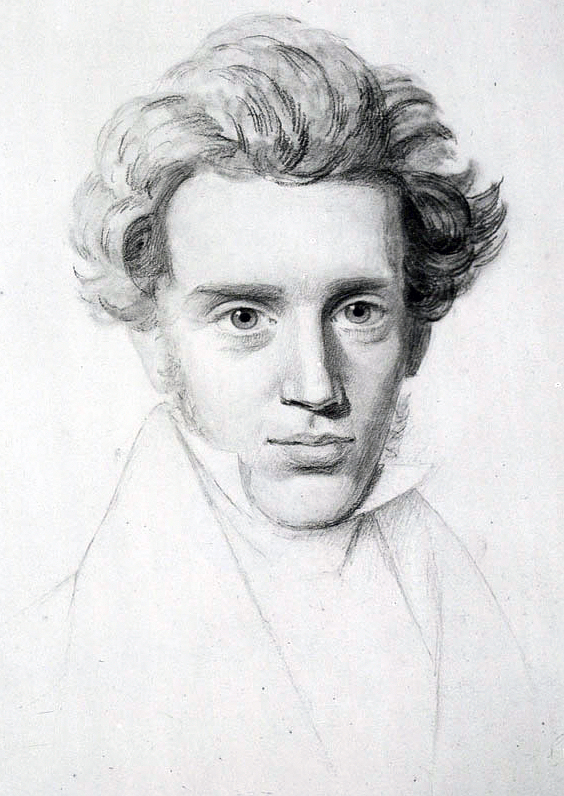


Image result for kierkegaard
Soren Kierkegaard

20:11-end

1. Compromise is ___________
2. Let's look a bit more ______________ly at the art of compromise.
3. What is Kierkegaard's conclusion about human nature?

Excerpt 

IT’S one of the things we are most afraid might happen to us. We go to great l___ths to avoid it. And yet we do it all the same: We marry the wrong person. 
Partly, it’s because we have a be___ering array of problems that emerge when we try to get close to others. We seem normal only to those who don’t know us very well. In a wiser, more s___-aware society than our own, a s____ard question on any early dinner date would be: “And how are you crazy?” 
Perhaps we have a latent t___ency to get furious when someone disagrees with us or can relax only when we are working; perhaps we’re tricky about intim___ after sex or clam up in response to humiliation. Nobody’s perfect. The problem is that before marriage, we rarely d__ve into our complexities. Whenever c__ual relationships threaten to __veal our f__ws, we blame our partners and call it a d__ (              ). As for our friends, they don’t care enough to do the hard work of enl____ening us. One of the privil___s of being on our own is therefore the sincere __pression that we are really quite easy to live with. 

Our partners are no more self-aware. Naturally, we make a st__b at trying to understand them. We visit their families. We look at their photos, we meet their college friends. All this contributes to a sense that we’ve done our h___work. We haven’t. Marriage ends up as a hopeful, generous, __finitely kind gamble (r     o    t    d     ) taken by two people who don’t know yet who they are or who the other might be, b__ding themselves to a future they cannot __ceive of and have c___fully avoided investigating. 


Wednesday, July 2, 2025

The Sonnets


Sonnet 116: Let me not to the marriage of true minds

Related Poem Content Details


Let me not to the marriage of true minds 
Admit impediments. Love is not love 
Which alters when it alteration finds, 
Or bends with the remover to remove. 
O no! it is an ever-fixed mark 
That looks on tempests and is never shaken; 
It is the star to every wand'ring bark, 
Whose worth's unknown, although his height be taken. 
Love's not Time's fool, though rosy lips and cheeks 
Within his bending sickle's compass come; 
Love alters not with his brief hours and weeks, 
But bears it out even to the edge of doom. 
    If this be error and upon me prov'd, 
    I never writ, nor no man ever lov'd.

Listen:

Sonnet 116

Read in a Stratford accent:

Sonnet 116

"The eminent Shakespearean scholar John Barton has suggested that Shakespeare's accent would have sounded to modern ears like a cross between a contemporary Irish, Yorkshire and West Country accent.
Others say that the speech of Elizabethans was much quicker than it is in modern-day Shakespeare productions."
Task:

1. Divide the poem into 3 stanzas and a couplet.
2. Work out the metre and rhyme scheme.
3. Do the next two poems have the same format?


Sonnet 12: When I do count the clock that tells the time

Related Poem Content Details

When I do count the clock that tells the time, 
And see the brave day sunk in hideous night; 
When I behold the violet past prime, 
And sable curls all silver’d o’er with white;
When lofty trees I see barren of leaves 
Which erst from heat did canopy the herd,
And summer’s green all girded up in sheaves 
Borne on the bier with white and bristly beard, 
Then of thy beauty do I question make, 
That thou among the wastes of time must go,
Since sweets and beauties do themselves forsake
And die as fast as they see others grow; 
   And nothing ‘gainst Time’s scythe can make defence
   Save breed, to brave him when he takes thee hence.

Notice the repetition "when" and "and"  - notice how the word "save" means "except" here and that it is also an exceptional word in the poem's structure.

Something I like about this poem is the way it blurs the lines between self and other in order to sow doubt. Everything is allowed a degree of will: time, trees, beauty. But all also cannot escape their limitations. Even time can't prevent nature from defying oblivion.

Sonnet 12

quizlet quiz


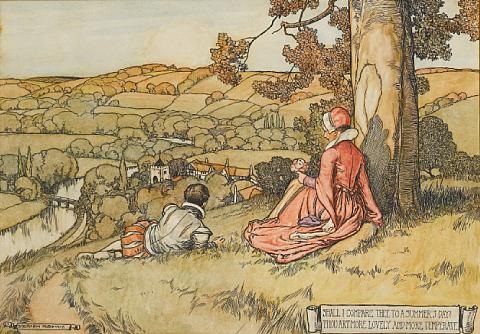
Sonnet 18: Shall I compare thee to a summer’s day?

Related Poem Content Details

Shall I compare thee to a summer’s day?
Thou art more lovely and more temperate:
Rough winds do shake the darling buds of May,
And summer’s lease hath all too short a date;
Sometime too hot the eye of heaven shines,
And often is his gold complexion dimm'd;
And every fair from fair sometime declines,
By chance or nature’s changing course untrimm'd;
But thy eternal summer shall not fade,
Nor lose possession of that fair thou ow’st;
Nor shall death brag thou wander’st in his shade,
When in eternal lines to time thou grow’st:
   So long as men can breathe or eyes can see,
   So long lives this, and this gives life to thee.


Shakespeare tends to use very basic grammatical words as the hinges in his sonnets. Can you remember / guess the missing words in these lines (note how often the first word of a line is a conjunction or other grammatical word).   


____ I compare thee to a summer’s day?
____ art more lovely and more temperate:
Rough winds ___ shake the darling buds of May,
___ summer’s lease hath all too short a date;
______ too hot the eye of heaven shines,
And ____ is his gold complexion dimm'd;
And every fair ____ fair sometime declines,
___ chance or nature’s changing course untrimm'd;
___ thy eternal summer shall not fade,
___ lose possession of that fair thou ow’st;
___ shall death brag thou wander’st in his shade,
___ in eternal lines to time thou grow’st:
   ___ long as men can breathe or eyes can see,
   ___ long lives this, ___ this gives life to thee.


Notice the same thing here in Sonnet 73

Sonnet 73: That time of year thou mayst in me behold

Related Poem Content Details

That time of year thou mayst in me behold
When yellow leaves, or none, or few, do hang
Upon those boughs which shake against the cold,
Bare ruin'd choirs, where late the sweet birds sang.
In me thou see'st the twilight of such day
As after sunset fadeth in the west,
Which by and by black night doth take away,
Death's second self, that seals up all in rest.
In me thou see'st the glowing of such fire
That on the ashes of his youth doth lie,
As the death-bed whereon it must expire,
Consum'd with that which it was nourish'd by.
This thou perceiv'st, which makes thy love more strong,
To love that well which thou must leave ere long.
Sonnet 73 sung by Paul Kelly


that time of year (1): i.e., being late autumn or early winter. 

When yellow leaves... (2): compare Macbeth (5.3.23) "my way of life/is fall'n into the sere, the yellow leaf." 

Bare ruin'd choirs (4): a reference to the remains of a church or, more specifically, a chancel, stripped of its roof and exposed to the elements. The choirs formerly rang with the sounds of 'sweet birds'. Some argue that lines 3 and 4 should be read without pause -- the 'yellow leaves' shake against the 'cold/Bare ruin'd choirs.' If we assume the adjective 'cold' modifies 'Bare ruin'd choirs', then the image becomes more concrete -- those boughs are sweeping against the ruins of the church. Some editors, however, choose to insert 'like' into the opening of line 4, thus changing the passage to mean 'the boughs of the yellow leaves shake against the cold like the jagged arches of the choir stand exposed to the cold.' Noted 18th-century scholar George Steevens commented that this image "was probably suggested to Shakespeare by our desolated monasteries. The resemblance between the vaulting of a Gothic isle [sic] and an avenue of trees whose upper branches meet and form an arch overhead, is too striking not to be acknowledged. When the roof of the one is shattered, and the boughs of the other leafless, the comparison becomes more solemn and picturesque" (Quoted in Smith, p. 148). 

black night (7): a metaphor for death itself. As 'black night' closes in around the remaining light of the day, so too does death close in around the poet.

Death's second self (8): i.e. 'black night' or 'sleep.' Macbeth refers to sleep as "The death of each day's life" (2.2.49). 

In me thou see'st...was nourish'd by (9-12): The following is a brilliant paraphrase by early 20th-century scholar Kellner: "As the fire goes out when the wood which has been feeding it is consumed, so is life extinguished when the strength of youth is past." (Quoted in Rollins, p. 191) 

that (12): i.e., the poet's desires. 

This (14): i.e., the demise of the poet's youth and passion. 

To love that well (12): The meaning of this phrase and of the concluding couplet has caused much debate. Is the poet saying that the young man now understands that he will lose his own youth and passion, after listening to the lamentations in the three preceding quatrains? Or is the poet saying that the young man now is aware of the poet's imminent demise, and this knowledge makes the young man's love for the poet stronger because he might soon lose him? What must the young man give up before long -- his youth or his friend? For more on this dilemma please see the commentary below. 

Steven Spielberg on virtual reality and cinema


Here are a few big Hollywood movies. Which were directed by Spielberg?


Jaws
Star Wars - The Empire Strikes Back
Raiders of the Lost Ark
ET
Blade Runner
Indiana Jones and the Temple of Doom
The Last Samurai
Jurassic Park
Schindler's List
The Hobbit
Saving Private Ryan
AI
Minority Report
Ready Player One


Image result for spielberg film about virtual reality

Ready Player One trailer

Interview with Spielberg on VR and Cinema

Listen from 3:15 - 5:33

Main idea:

Which two aspects of cinema does Spielberg feel VR cannot replace?

Discuss

Do you agree that VR can't be a narrative technology? 

Is Spielberg right?

Listen for detail:

Number these words in the order they are used:

protagonist
conventional
undermine
obfuscate
free range
strangers
confined to
movie going
diaspora
short leash
entirely


Check

obfuscate
protagonist
conventional
undermine
free range
strangers
entirely
short leash
confined to
movie going
diaspora


Grammar:

____ we made this film five years from now, we probably could have introduced virtual reality.

What do you notice about the tense used and the time referenced?


 Discuss

1. Do you enjoy writing? What do you get out of it?
2. What makes writing more interesting? What makes it boring?


Extract of a review of Ready Player One:


Do this quiz first:


12 collocations


Try to put these adjectives into the most suitable gaps. Warning - this is quite confusing!


furious        spectacular          striking          dingy          hectic       dazzling             stunning

Steven Spielberg’s 1._____ sci-fi action-adventure, Ready Player One, is set half in the real world and half in virtual reality, so it’s not surprising that two of its characters should discuss the differences between those competing realms. What’s  2.______ is that the characters should have their discussion in the middle of a 3. _____ gun battle in a zero-gravity disco – and yet you can somehow follow both their arguments and the course of the shoot-out.

It’s 4._____ stuff. Recently, a generation of directors has been paying homage to Spielberg’s popcorn films (in Super 8, Jurassic World, and Stranger Things, for example), but with Ready Player One he proves with 5._____ aplomb that no one does Spielberg quite like Spielberg. No one has more empathy with pasty American kids from broken homes. No one packs scenes with so much information, or elaborate action set pieces with so much energy, while ensuring that you always know what’s going on and why.

And Spielberg isn’t just competing with his imitators and his 1980s self. He is blasting his way into the 21st Century. As his  6.______ film travels back and forth between a 7.____ Orwellian dystopia and a computer-generated dream world, he stampedes across territory occupied by Terry Gilliam, James Cameron, Christopher Nolan and the Wachowskis, not to mention the directors of The Lego Movie. He isn’t just making this territory his own, but demonstrating that it was his all along.

Discuss:

1. What is different about the adjectives I removed and the ones I made bold?
2. What in the end, was the most suitable arrangement of the adjectives? Did you learn something by figuring this out? What exactly?


Which selection from the text illustrates the the reviewer’s key point?

A) a generation of directors has been paying homage to Spielberg’s popcorn films
B) He isn’t just making this territory his own, but demonstrating that it was his all along.
C) he stampedes across territory occupied by Terry Gilliam, James Cameron, Christopher Nolan and the Wachowskis,


 Try to put these adjectives / participles into the right gaps.

Adapted from        higgledy-piggledy      orphaned         rundown       infinite     vertiginous

 7.__________ the best-selling novel by Ernest Cline, and scripted by Cline and Zak Penn, Ready Player One is set in the year 2045. Its 8.______ hero, Wade (Tye Sheridan), lives in a grey Ohio ghetto called The Stacks, where  9._________ skyscrapers are made of mobile homes piled on top of each other and held together with scaffolding. This opening setting would be enough to occupy most films, but no sooner have we glimpsed Wade’s 10.______ home than he slips on his VR gloves and helmet and flits across to the OASIS, an online role-playing game.

Most of the population passes most of its time in this game, it seems. The America of 2045 is so 11.______ that it makes sense to cross over to an 12.______ digital wonderland where you can live in every film you’ve ever seen.


Analysis:

Each of the things in bold is kind set formula that is constantly used in this kind of writing.

Adapted from the best-selling novel by Ernest Cline, and scripted by Cline and Zak Penn, Ready Player One is set in the year 2045. Its orphaned hero, Wade (Tye Sheridan), lives in a grey Ohio ghetto called The Stacks, where higgledy-piggledy skyscrapers are made of mobile homes piled on top of each other and held together with scaffolding. This opening setting would be enough to occupy most films, but no sooner have we glimpsed Wade’s vertiginous home than he slips on his VR gloves and helmet and flits across to the OASIS, an online role-playing game.

They all have the same purpose really: to pack the information in tightly and to link it smoothly. In contemporary English it's often seen as "good writing" to be able to condense your ideas efficiently. Why do you think this is?

Do you think it would be the same for Spanish, French or German?


IELTS Speaking test analysis

 Full test demo -5.5


Thai candidate 


Examples of different candidates


French speaker