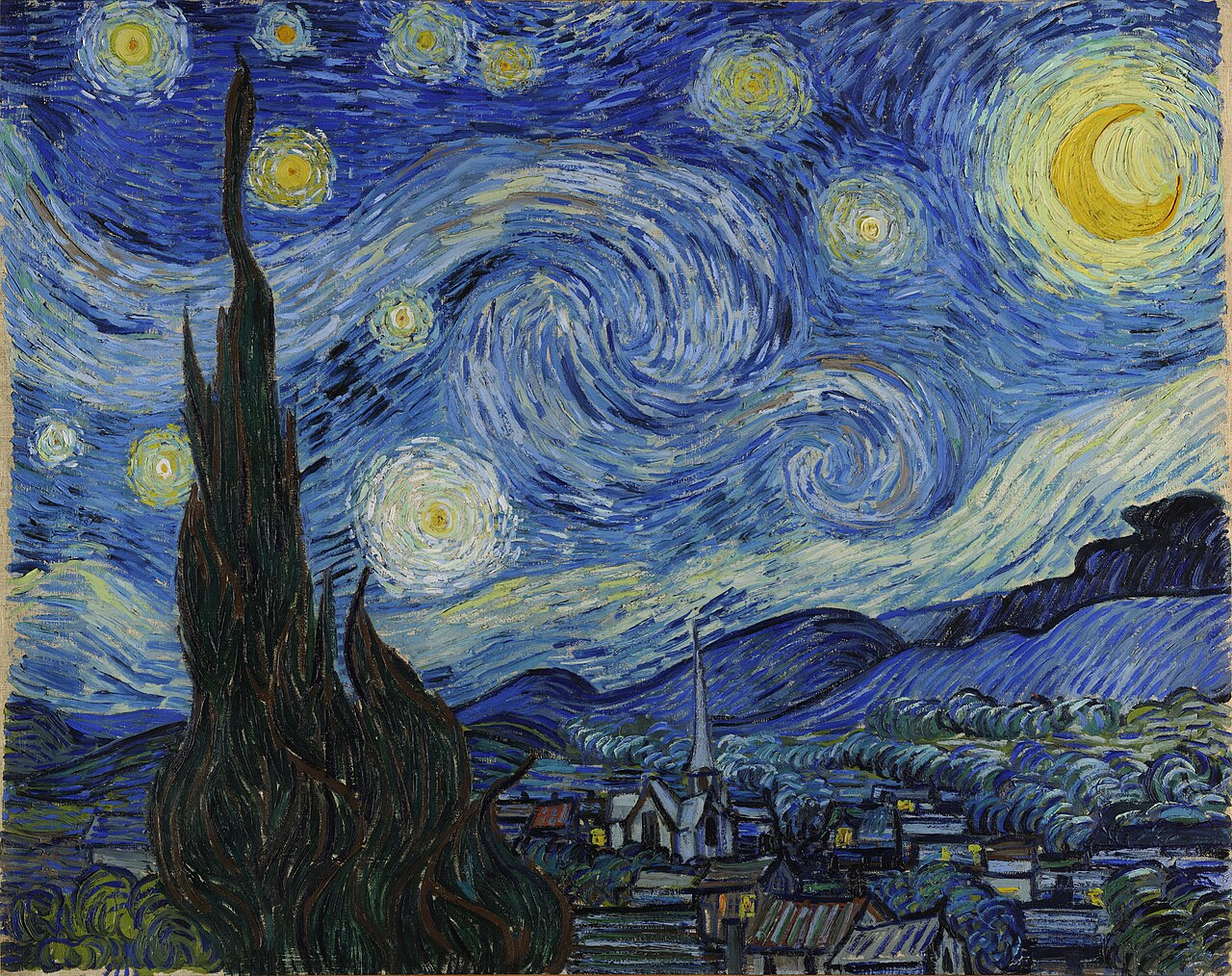
What is the visual phenomenon the painter is trying to
convey?
Why not just take a photograph?
This is one of the most popular and famous paintings in the
world. Why?
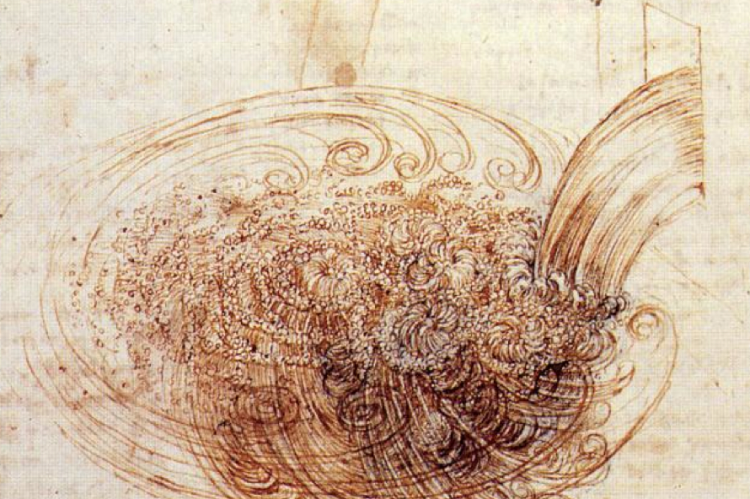
Try to represent the following things in six simple
drawings:
Water flowing
Smoke
Clouds and mist
Fire
Reflections on a shiny surface
oil
What kinds of lines are used to represent these forms?
Lead in: What do you think makes this picture so well loved?
Look at the title:
“The unexpected math behind Van Gogh’s ‘Starry Night’
by Natalya St. Clair:
What do you think the article will say about the picture?
Read the article and find out:
One of the most remarkable aspects
of the human brain is its ability to recognize patterns and describe them.
Among the hardest patterns we’ve tried to understand is the concept of
turbulent flow in fluid dynamics.
The German physicist Werner
Heisenberg said, “When I meet God, I’m going to ask him two questions: why relativity
and why turbulence? I really believe he will have an answer for the first.”
As difficult as turbulence is to
understand mathematically, we can use art to depict the way it looks.
In June 1889, Vincent van Gogh
painted the view just before sunrise from the window of his room at the
Saint-Paul-de-Mausole asylum in Saint-Rémy-de-Provence, where he’d
admitted himself after mutilating his own ear in a psychotic episode.
In “The Starry Night,” his
circular brushstrokes create a night sky filled with swirling clouds and
eddies of stars.
Van Gogh and other Impressionists
represented light in a different way than their predecessors, seeming to
capture its motion, for instance, across sun-dappled waters, or here in
starlight that twinkles and melts through milky waves of blue night sky.
The effect is caused by luminance,
the intensity of the light in the colors on the canvas.
The more primitive part of our visual
cortex, which sees light contrast and motion but not color, will blend two
differently colored areas together if they have the same luminance.
But our brain’s primate
subdivision will see the contrasting colors without blending.
With these two interpretations
happening at once, the light in many Impressionist works seems to pulse,
flicker, and radiate oddly.
That’s how this and other
Impressionist works use quickly executed, prominent brushstrokes to
capture something strikingly real about how light moves.
Sixty years later, Russian
mathematician Andrey Kolmogorov furthered our mathematical understanding
of turbulence when he proposed that energy in a turbulent fluid at
length R varies in proportion to the five-thirds power of R.
Experimental measurements show
Kolmogorov was remarkably close to the way turbulent flow works, although a
complete description of turbulence remains one of the unsolved problems in
physics.
A turbulent flow is self-similar
if there is an energy cascade.
In other words, big eddies
transfer their energy to smaller eddies, which do likewise at other scales.
Examples of this include Jupiter’s
Great Red Spot, cloud formations, and interstellar dust particles.
In 2004, using the Hubble Space
Telescope, scientists saw the eddies of a distant cloud of dust and gas around
a star, and it reminded them of Van Gogh’s “Starry Night.”
This motivated scientists from
Mexico, Spain, and England to study the luminance in Van Gogh’s paintings in
detail.
They discovered that there is a
distinct pattern of turbulent fluid structures close to Kolmogorov’s equation
hidden in many of Van Gogh’s paintings.
The researchers digitized the
paintings and measured how brightness varies between any two pixels.
From the curves measured for pixel
separations, they concluded that paintings from Van Gogh’s period of psychotic
agitation behave remarkably similar to fluid turbulence.
His self-portrait with a pipe,
from a calmer period in Van Gogh’s life, showed no sign of this correspondence.
And neither did other artists’
work that seemed equally turbulent at first glance, like Munch’s “The Scream.”
While it’s too easy to say Van
Gogh’s turbulent genius enabled him to depict turbulence, it’s also far
too difficult to accurately express the rousing beauty of the fact that, in a
period of intense suffering, Van Gogh was somehow able to perceive and
represent one of the most supremely difficult concepts nature has ever brought
before mankind, and to unite his unique mind’s eye with the deepest mysteries
of movement, fluid, and light.
Go to Ted Lesson:
The math behind Van Gogh's "Starry Night"
Descension
- One
key ability of the human brain is recognizing _________ and being able to
describe them.
- Among
the most difficult patterns scientists study is ________ in ________
dynamics.
- The
physicist _________ once said he would ask God about _________ and _________.
- In
June 1889, _________ created a painting based on the view from his room in
an asylum in _________.
- In The
Starry Night, _________ brushstrokes form a sky full of swirling _________
and starry eddies.
- Impressionist
artists showed _________ in a new way, capturing its _________ in scenes
like water or the night sky.
- This
visual effect comes from _________, meaning the intensity of _________ in
the colors used.
- In
1941, _________ suggested that energy in turbulent flow depends on the _________
power of length.
- In
turbulent flow, an _________ cascade occurs, where larger eddies pass
energy to _________ ones.
- Researchers
later found that the luminance patterns in Van Gogh’s paintings resemble _________,
especially during times of _________ agitation.
As
Episode
Without
likewise
at once
Depict
Include
varies
strikingly
blend
admitted
distinct
1. _____ difficult as turbulence is to understand
mathematically, we can use art to 2._______the way it looks.
In June 1889, Vincent van Gogh painted the view just before
sunrise from the window of his room at the Saint-Paul-de-Mausole asylum in
Saint-Rémy-de-Provence, where he’d 3._________ himself after mutilating his own
ear in a psychotic 4.________.
The more primitive part of our visual cortex,
which sees light contrast and motion but not color, will 5.________ two
differently colored areas together if they have the same luminance. But our
brain’s primate subdivision will see the contrasting colors 6._________blending.
With these two interpretations happening 7._________, the
light in many Impressionist works seems to pulse, flicker, and radiate oddly.
That’s how this and other Impressionist works use
quickly executed, prominent brushstrokes to capture something 8.__________
real about how light moves.
…big eddies transfer their energy to smaller eddies, which
do 9.__________ at other scales.
Examples of this 10.________ Jupiter’s Great Red Spot, cloud
formations, and interstellar dust particles.
Scientists discovered that there is a 11.________ pattern of
turbulent fluid structures close to Kolmogorov’s equation hidden in many of Van
Gogh’s paintings.
The researchers digitized the paintings and measured how
brightness 12._________ between any two pixels.
Hannah Gadsby: Nanette | The Sunflowers
lead in:
Who painted this?
If I give you "unsolicited" advice, does it mean the advice is...
A) poorly researched?
B) unasked for?
C) not from a lawyer?
D) not advice that I follow myself?
Discuss
1. Should people who suffer from mental illness take medication or try to cope without it?
2. Is there a connection between artistic talent and mental instability?
3. How might the medication van Gogh was taking have actually been partly responsible for the Sunflowers?
Guide questions
1. According to the man, why should artists not take medication for mental health problems?
Kahoot Quiz
The Math of Starry Night

No comments:
Post a Comment