Wednesday, April 30, 2025

How to Find Fulfilling Work


Discuss:

1. Do you have a clear idea of your working future or are are you still trying to find your vocation?

2. Why is it so hard for many people to make up their minds about the career they want?

Vocab: what's the missing letter?

_rosperous
_abour
a big _sk
_rises (plural of _risis)
perfectly _ormal
at _ost
_aradox
_aralysis
to _cknowledge
_rise spontaneously
have a _alling
_ommanding (adj)
_erilous (adj)
be at the _ercy of
to _ick up on
to _ark concerns
_uthentic (adj)
off-_eat
in _eed of
_ustained reflection
_ar from it
_onundrum
un_ittingly (adv)
_ata
to _ollide
non-_rrevocable
_ranching projects
at heart
to _lex your muscles
_et again
to _ismiss sth
nothing _ess than
_nternalised (adj)
_imidity
_oubt

Watch:

How to Find Fulfilling Work

Take notes:


  •  The word ___________ doesn't appear in Dr. Johnson's Dictionary (published: _____)


  • Besides income, many modern people expect to get _________ and ___________ from work.


  • Six useful ideas for finding fulfilling work:


1. _______________________ is normal. This is called the "_________ of choice"

2.______________________ - the oldest philosophical recommendation.
- set aside the money problem so you can sort out what you actually _____________

3. _________ a lot. It's not i_________gent to take your time on this important decision.

4. __________________. We need to c_________ with the real world in order to understand ourselves.

5. ___________ what makes people unhappy. These things are b_______  o__________s.
Work is really a c_______ for us to ______.
- The idea that "everything has been done and tried is n__________.

6. Be ______________. Many of the top jobs simply go to those who _____ to ask for them.
- a lack of confidence is actually a ___________ of how the world works.


  • The ultimate criterion for a career is one we won't _________________________.


Write these in the order you hear them:


at most

yet again

nothing less than

timidity

in need of

off-beat (adj)

perilous (adj)

far from it

non-irrevocable

at heart (used twice)

to pick up on

to acknowledge


Check

at most

to acknowledge

perilous (adj)

to pick up on

off-beat (adj)

in need of

far from it

non-irrevocable

at heart

yet again

nothing less than

timidity


Monday, April 28, 2025

The Best Kindergarten You've Ever Seen


What country?


What country?


Image result for japanese architecture


What country?

Image result for japanese architecture


OpinionSizeOtherAgeShape
Spectaculartallilluminatedmodernthin
ColourPatternOriginMaterialPurpose
greyplaininternationalconcretelandmark


What country?

Image result for japanese architecture


OpinionSizeOtherAgeShape
Spectaculartallilluminatedmodernthin
ColourPatternOriginMaterialPurpose
greyplaininternationalconcretelandmark


What country?Image result for japanese architecture


They're all Japanese!


What do they all have in common?


Discussion:

Can you remember Kindergarten? Or maybe primary school? What was the building like?

Do you have good or bad feelings about it?
Was it an old or new building?
How large was the building and the rooms?
Was it open-plan?
Was there a lot of natural light?
Was the floor carpeted, tiled, wood, concrete...?
What sticks out in your memory?
Were there lots of trees around?
What could you see out the windows?
What was the furniture like?
Were there any unusual spaces, unusual climbing frames??
Was it colourful?
Does it still exist?


The Best Kindergarten You've Ever Seen


At this school in Tokyo, five-year-olds cause traffic jams and windows are for Santa to climb into. Meet: the world's cutest kindergarten, designed by architect Takaharu Tezuka. In this charming talk, he walks us through a design process that really lets kids be kids.

Watch:

The Best Kindergarten You've Ever Seen


1. What do most parents know kids love to do?

2. What did the principal of the kindergarten want to use to prevent the children falling off the roof?

3. Why did the designers make the roof so low?

4. How do some kids react to being put in a quiet space?

5. What does noise help kids to do?

6. What do kids do around the well?

7. What is a skylight?

8. How many floors does the annex building have?

9. What does a little dose of danger help the kids to learn?

10. What does the drawing show?

11. What is Takaharu's philosophy about injury?


Key word: __ __ __ __ __ __ __ __ __ __  (10 letters)


Sunday, April 27, 2025

A History of Early English


Frisian words of West Germanic origin


Buter

Brea

Tsiis

Miel

Sliepe

Boat

See

Stoarm


The 5th Century AD 


Jutes, Angles and Saxons 


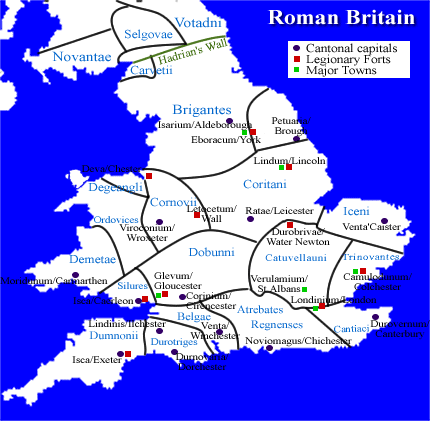
500 years earlier the Romans had invaded Britain. 


Anglo-Saxons


Celtic words that survive in Modern English


Crag


Thames, Avon, Dover, London


Anglo-Saxon place names


The –ing in modern place names like Hastings, Dorking, means “the people of

The ton in  Bridlington and Chessington, means “enclosure or village”

The ham in Birmingham, Cheltenham and Tottenham means “farm”


7th Century AD


Some Latin words entered the vocabulary:


Altare

Mass

Monk

Verse


The Latin alphabetic script was also introduced. 


The Germanic invaders had brought runes with them. 


Lindisfarne Gospels were created in the 8th Century on the island of Lindisfarne. 


The Sack of Lindisfarne


The use of “son” in surnames is comes from Norse:


Nicholson

Harrison

Robson

Dickenson

Watson

Johnson

Richardson


These names are still more common in the areas that were settled by the Danes.


The sk sound is characteristic of Old Norse:


Skor

Skye

skil


Other Norse words absorbed into English include:


Angr

Knif

Vindauga


Sometimes the English and Norse words for the same thing were both retained, but each gained a slightly different meaning:


Old English:

Craft

Hide

Sick


Old Norse:

Skill

Skin

Ill


In this way the richness and flexibility of the vocabulary increased.


Other Norse words:


Law

Egg

Husband

Leg

Die

Ugly

They

Their

Them


Beowulf


Beowulf in Old English


"bone-house”

“War-board,

“joy-wood”


1066


Enemi

Castel

Armee

Archier

Soudier

Garison

Garde


French also spelled out the new social order:


corune

Trone

Cort

Duc

Baron

Nobilte

Paisant

Vassal

Servant

Governer

Liberte

Autorite

Obedience

Traitre


In Law:


Felonie

Arester

Warant

Justise

Juge

Juree

acuser

aquiter

sentence

condemner

prisun

gaiole


Food - cuisine 


Porc

Saussiche

Bacun

Fruit

Orenge

Limon

Grappe

Olive

Boef

Salade

Diner


Not one of the great landowners spoke English

Written English disappeared. 

The language was forced underground.


Ox / Cow

Beef


Sheep

Mutton


Calf

Veal


Deer

Venison


Pig

Pork


The French influence over English is enormous in terms of vocabulary


but not in terms of grammar.


The majority of French words don’t replace Old English, they stand alongside them. 


E.g.. Apple


Early 13th century 


trade was on the increase. 


The wool trade made partof England rich. 


London’s population would double over the century. 


The English speaking middle classes picked up many French words.


Merchant

Money

Price

Discount

contract

Partner


The English middle classes also adopted French names:


Richard

Robert

Simon

Steven

John

Jeffery

William


But Normandy became part of the smaller empire of France and the Normans of England lost their connections across the channel. 


French speakers in England began to take English wives and thus married into the language.


Yet even as French began to wane as a language, it’s vocabulary poured even faster into Englishpartly because French was the international language of trade. 


Also because of this, French became a conduit for words from the markets of the East: Arabic words like


Saffron

Mattress

Hazard

Alchemy

Amber

Syrup

Checkmate (the king is dead)


“Almost synonyms”


Swan

Signet


Ask

Demand


Bit

Morsel


Wish

Desire


Might

Power


Room

Chamber


Answer

Respond


Begin

Commence


Freedom

Liberty


The Black Death


In the mid 14th Century the Black Death wiped out most of the nobility. 


The Black Death meant the end of Latin, because so many of the Latin-speaking clergy died.


Most of their replacements were illiterate English speakers. 


Wages rose. 


The price of property fell. 


The common people began to rise through society, taking their language with them. 


In 1362, English was acknowledged as a language of official business. 


Court cases could be pleaded, debated and judged in English


King Henry IV (1367 –1413) was the first English speaking King in 300 years.


The Decameron by Giovanni Boccaccio- composed in the 1350s


Geoffery Chaucer 


Geoffery Chaucer began The Cantebury Tales in 1387. 


He was a Londoner with connections to the royal family. 


He knew Latin and French, but he chose to write in London English


It was a vibrant, cosmopolitan variety of English


The characters in the tales, the pilgrims, are a cross-section of medieval society.