Wednesday, October 29, 2025

Emphatic Stress

 Emphatic stress


Choose the correct option

1. In English you don't have to / have to change the word order to change the meaning.

2. In the sentence "I was extremely tired", 

the standard stress is on the word "extremely" / "tired".

3. We often place emphatic stress on adjective / intensifiers

4. You can / can't choose to place stress on adjectives.

5. When we say "so happy: we must stress so / happy.

6. In the sentence "she's so happy that she can't stop smiling", we can / can't leave out the word "that".

7. Emphatic stress can / can't express a negative meaning.

8. It is / isn't always adverbs that receive emphatic stress.


Practice


A) It was very cold. (standard stress)

B) It wasn't really. (emphatic stress)

A) Yes it was! (contrastive stress) 

B) I thought it was cold, but not extremely cold.

A) It was absolutely freezing cold. (emphatic stress) It was so cold that I couldn't move my fingers. (standard stress)


A) He's a terrible liar.

B) Really? I thought he was telling the truth.

A) Never! He always lies. He's a terrible liar.

B) Okay. I'll remember that.


A) What on earth made you do that?

B) I thought it would make you happy.

A) I don't believe that at all. It made extremely angry!

B) Okay. Then I'm extremely sorry.


Emphatic modals


(exercise 2b)

In each question, underline the modal (in gray italics) if you think it would be appropriate to stress or emphasise it. 

1.I don't have much time, but I suppose I could do it if it's really necessary. 
2.can help you with that if you like. 
3.shall be seeing him tomorrow, do you want me to give him a message? 
4.Cinderella! You shall go to the ball! 
5.But you must remember to leave before midnight. 
6.As a rule, drivers must keep to the speed limit at all times. 
7.You should ask your teacher if you can have an extension. 
8.should have told you earlier about this, but I forgot. 
9.may have left it at home, but I was sure I had brought it. 
10.By the way, I might be a bit late this evening; I'm meeting a client.


Tuesday, October 28, 2025

IELTS essay skills


Exercise 1: Cars and city centers

(Topic: Ban cars from city centers)

Reorder the following sentences to form a well-structured paragraph:

A. Cars produce harmful gases like carbon dioxide and nitrogen oxides, which can damage the environment and people's health.
B. One strong reason to ban cars from city centers is to reduce air pollution.
C. For example, a study in London found that air pollution levels dropped by 30% after restrictions were placed on cars in central areas.
D. Therefore, banning cars can make city centers cleaner and healthier places to live and work.

1 (Topic sentence) _A__

2 (Development sentence) ___

3 (Example giving sentence) ___

4 (Concluding sentence) ___


Exercise 2: Children and mobile phones

(Topic: Children should not use mobile phones at a young age)

Reorder the following sentences to form a well-structured paragraph:

A. For instance, many teachers report that students who are on their phones frequently have more trouble focusing in class and working with classmates.
B. Giving mobile phones to young children can negatively affect their mental development.
C. As a result, allowing children to use phones at a young age could harm their ability to learn and communicate effectively.
D. When children spend too much time on phones, they may have fewer face-to-face interactions and become less socially skilled.

1 (Topic sentence) ___

2 (Development sentence) ___

3 (Example giving sentence) ___

4 (Concluding sentence) ___


Exercise 3: Physical education in schools

(Topic: Physical education is as important as academic subjects)

Reorder the following sentences to form a well-structured paragraph:

A. Many children today spend too much time sitting, either at desks or in front of screens, which can lead to obesity and other health problems.
B. This shows that making physical education a regular part of the school day can support both physical health and academic success.
C. For example, schools in Finland that include daily exercise sessions report lower rates of childhood obesity and better overall student concentration.
D. Physical education is essential because it helps students stay healthy and active.


1 (Topic sentence) ___

2 (Development sentence) ___

3 (Example giving sentence) ___

4 (Concluding sentence) ___


Find some errors


Old buildings are fascinating because they told the story of the past. Many of these buildings is made of strong materials like stone and brick, which have help them survive for many year. Some old building was once homes, while others used for important events, like church or castle. When you visited these buildings, you can saw the detail of their architectures, such as tall window, wooden door, or carved decoration. The buildings is often very large, and it take a lot of work to maintain it. People doesn't always realizes how many history they surrounded by. This buildings holding memories from past, and it tells us about the differents period in history. By look at it, we can learning how peoples lived and worked in past.


Now look at the italicised words. Can you change them to improve the writing

Old buildings are fascinating because they told the story of the past. Many of these buildings is made of strong materials like stone and brick, which have help them survive for many year. Some old building was once homes, while others used for important events, like church or castle. When you visited these buildings, you can saw the detail of their architectures, such as tall window, wooden door, or carved decoration. The buildings is often very large, and it take a lot of work to maintain it. People doesn't always realizes how many history they surrounded by. This buildings holding memories from past, and it tells us about the differents period in history. By look at it, we can learning how peoples lived and worked in past.


Use the gaps to write you corrections

Old buildings are fascinating because they ______ the story of the past. Many of these buildings ___ made of strong materials like stone and brick, which have _____ them survive for many _____. Some old ________ ____ once homes, while others ____ used for important events, like ______ or ______. When you _______ these buildings, you can _____ the _______ of their ___________, such as tall ________, wooden _______, or carved _________. _______ buildings ___ often very large, and it _____ a lot of work to maintain _____. People _______ always ______ how ______ history they _____ surrounded by. _____ buildings _______ memories from ___ past, and ____ ______ us about the ________ _______ in history. By ______ at _____, we can ______ how ______ lived and worked in ____ past.


You should spend about 40 minutes on this task.

Write about the following topic:

Many old buildings protected by law are part of a nation’s history. Some people think they should be knocked down and replaced by news ones.

How important is it to maintain old buildings?

Should history stand in the way of progress?

Give reasons for your answer and include any relevant examples from your own experience or knowledge.

Write at least 250 words.

Most nations around the world have at least some, or possibly many, old buildings. There are temples, churches and houses in their cities, villages and surrounding areas. These buildings have historical significance. It is very important to maintain these. It does not mean progress should stop.

Preserving certain old buildings is important for several reasons. These structures provide an insight into the history of our countries. They show us how people many centuries ago lived their lives. Without them, we could only learn by books. It would undoubtedly be sad if this were the only way to see them. Many of these buildings are very beautiful. Take the many religious buildings. There are churches and temples we see around the world. Many of these buildings provide important income to a country. Many tourists visit them in great numbers.

This certainly does not mean that modernization should be discouraged. I believe old buildings can be protected in tandem with progress. In many circumstances we see old historic buildings being renovated. Their original character is maintained. They are used for modern purposes. In no way does history hinder progress. It is the opposite. We study and learn about our history. We understand more about the world we live in. This helps us to build a better future.

I believe it is very important to protect and preserve old buildings. We can learn about our history. Others from other countries can learn about their history. Such knowledge can help us to understand how to modernise our countries in the best way.


Most nations around the world have at least some, or possibly many, old buildings ____ ___ temples, churches and houses in their cities, villages and surrounding areas ____ have historical significance. __ ___ _______, it is very important to maintain these, ____ this does not mean progress should stop.

Preserving certain old buildings is important for several reasons. ____, these structures provide an insight into the history of our countries, show___ us how people many centuries ago lived their lives. Without them, we could only learn by books, and it would undoubtedly be sad if this were the only way to see them. Many of these buildings are ____ very beautiful. Take ___ ______ the many religious buildings ___ __ churches and temples ____ we see around the world. ___ ____ this, ___ on a more practical level, many of these buildings provide important income to a country ___ many tourists visit them in great numbers.

_____, this certainly does not mean that modernization should be discouraged. I believe ___ old buildings can be protected in tandem with progress. ___ _____, in many circumstances we see old historic buildings being renovated _____ maintaining their original character, ____ being used for modern purposes. ___, in no way does history hinder progress, ___ ___ ____ it is the opposite. ___ studying and learning about our history, we understand more about the world we live in, ___ this helps us to build a better future.

___ _______, I believe ___ it is very important to protect and preserve old buildings ___ we can learn about our history ___ can others from other countries. Such knowledge can ____ help us to understand how to modernise our countries in the best way.


Most nations around the world have at least some, or possibly many, old buildings such as temples, churches and houses in their cities, villages and surrounding areas which have historical significance. In my opinion, it is very important to maintain these, but this does not mean progress should stop.

Preserving certain old buildings is important for several reasons. Firstly, these structures provide an insight into the history of our countries, showing us how people many centuries ago lived their lives. Without them, we could only learn by books, and it would undoubtedly be sad if this were the only way to see them. Many of these buildings are also very beautiful. Take for example the many religious buildings such as churches and temples that we see around the world. Not only this, but on a more practical level, many of these buildings provide important income to a country as many tourists visit them in great numbers.

However, this certainly does not mean that modernization should be discouraged. I believe that old buildings can be protected in tandem with progress. For example, in many circumstances we see old historic buildings being renovated whilst maintaining their original character, and being used for modern purposes. Also, in no way does history hinder progress, and in fact it is the opposite. By studying and learning about our history, we understand more about the world we live in, and this helps us to build a better future.

To conclude, I believe that it is very important to protect and preserve old buildings as we can learn about our history as can others from other countries. Such knowledge can also help us to understand how to modernise our countries in the best way.

Sunday, October 26, 2025

Stereotypes and Generalisations (simplified version)

Aims:

Discuss stereotypes and where they come from.

Watch and discuss video clips which confront or exploit stereotypes.

Practice using adverbs of frequency.


National Stereotypes 1

Fill in the gaps:

1. Italian people eat ____ ever day
2. The best machines come from _____
3. ______ people are very serious
4. The ______ are the most romantic people
5. _______ like eating hamburgers

6. _______ see kangaroos every day
7. ______ are very spiritual people.
8. ______ are obsessed with rugby.
9. ______ like to party all the time.
10. ______ spend a lot of time surfing. 

What informed your choices? Are they based on real experience?


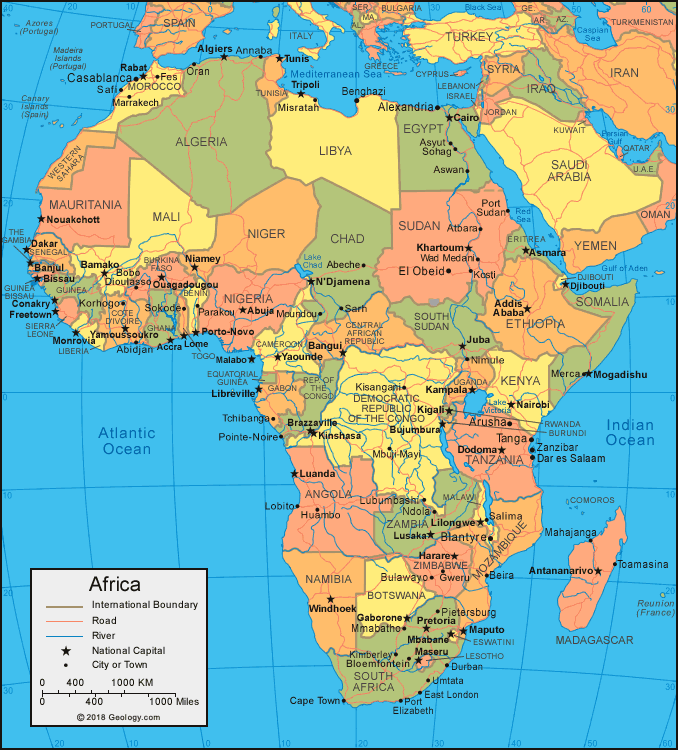
Africa


What comes to mind when you think of Africa?

P

H

W


Image result for africa


Pre-learn language:


1. What do the following figures refer to?

1.1 billion
54
2000
22
9
4/10
1 in 3
2%
52 billion
43 billion
7
64%
29%

Watch:

Reality Check


What is your reaction?
Did the video challenge your preconceptions about Africa?

2. How would you describe the presenter's attitude?

a) sarcastic
b) angry
c) diplomatic

What ways of using language reflect his attitude?

3. Language - what do the words in italics mean?


1. Conjures up lazy images

a) brings to mind
b) gets rid of
c) records

2. western handouts

a) money
b) loans
c) aid

3. How about the plight of poor African women?

a) suffering
b) deaths
c) health

4. The highest proportion of female parliamentarians in the world.

a) number
b) number compared with other countries
c) number compared with males

5. It's important that we focus only on the doom and gloom cross the continent.

a) wars
b) constructive work
c) despair


Watch: 

I don't need subtitles

Discuss the video - what is the video's message? 

Is this a respectful portrayal of middle eastern people?


National stereotypes 2

1, Are you ‘proud’ to be from your country?
2. What do people commonly say to you about your country? Is it positive or negative?
3. Think. What would you like people to ask you about?

Write some questions you would like others to ask you:


1.

2.

3.

4.

5.


4. What do you feel is really positive about your country?
5. What do you feel is negative?


Grammar: Generalising and using adverbs of frequency


Look at this sentence:


In New Zealand we don't often show real emotion in public. But sometimes we do - like after the Mosque attacks.


Which words could we have used instead of often and sometimes"


·       always 
·       almost always 
·       usually/ generally/ most of the time/ normally/ 
·       often 
·       fairly often 
·       sometimes 
.       no so often
·       occasionally / once in a while 
.       very rarely
.       never ever

These words are called adverbs of frequency


Think up a sentence for four of these about people in your city or people in your country:

Think about these things:

swearing
allowing you into their house
getting drunk
shouting in the street
dropping litter
crying in public
talking about art
talking about politics
spending the whole day indoors
complaining about their parents
complaining about the boss
going skinny dipping
haggle over prices
trusting strangers

E.g. 

People in my country almost always trust strangers. 

Aucklanders almost never spend the whole day indoors.


Question formation: 
Jumble Kahoot - questions


Advertising


White washing


Discuss the complexities of this advertisement.

How racist is it on a scale of 1-10?
"Smack and Cheese"


Burgerfuel Narcos spoof


BurgerFuel's latest campaign has come under fire from members of the Latin American community who say the advertising perpetuates negative stereotypes and capitalises on the drug war.
Advertising for the new Smack and Cheese burger plays on the word "smack" - slang for heroin or cocaine. It is themed around Colombian drug lord Pablo Escobar, the drug war and drug smuggling in South America.
A video advertising the burger is filmed in Spanish and features a Pablo Escobar-like character threatening and bribing soldiers as he attempts to smuggle "smack", which turns out to be macaroni, through the countryside.

Green Party candidate, Ricardo Menendez March, said he was concerned the campaign perpetuated negative stereotypes about the Latin American community, particularly that they are drug dealers.
"Latin Americans across the world already have to deal with commentary around the drug war and for many Latin Americans who come from violent areas, the drug war is quite close to us," he said.
"Some of us have friends and family members and acquaintances who have died as a result, and so to have to put up with those stereotypes can be really demoralising."
Following the election of US President Donald Trump - fuelled by anti-immigration sentiment, particularly targeting the Latin American and Muslim communities - such advertising could normalise some of the negative stereotypes the campaign was built on, Menendez March said.
"The Latin American community is rich in diversity and has a plurality of voices. Companies should not be exploiting narrow stereotypes for profit's sake."
BurgerFuel is yet to respond to repeated requests for comment.
Lorena Cuervo has been in New Zealand for two years and says since arriving she has been typecast when mentioning she is from Colombia.
"The following sentence is always related to cocaine: 'good stuff', 'oh! Yes, Pablo Escobar', 'did you bring some stuff to New Zealand?'," she said.
"I don't know why people think that it's funny, or even friendly, they obviously do not know the sadness and pain behind that. They ignore completely that in my country there are children without parents, parents without children because of the war."
Hearing things like this made you feel terribly discriminated against, she said, and seeing these messages in the media encouraged and even sanctioned this stigma.
"I know some people who would rather say that they are from another country instead of hearing those comments."
She believed it was inappropriate for BurgerFuel to use references to the drug war and the trade of cocaine in its advertising.
Menendez March thinks BurgerFuel has a responsibility to play a role in not inciting prejudice and racism.
"An acknowledgement from BurgerFuel that the ad was built upon some pretty negative stereotypes from a war that has cost thousands of lives in the Latin American region would be a start."

• Written by Sarah Murphy

Discuss the comments from the text:


1. "Latin Americans across the world already have to deal with commentary around the drug war and for many Latin Americans who come from violent areas, the drug war is quite close to us."


2.  "Following the election of US President Donald Trump - fuelled by anti-immigration sentiment, particularly targeting the Latin American and Muslim communities - such advertising could normalise some of the negative stereotypes the campaign was built on."


3. "The Latin American community is rich in diversity and has a plurality of voices. Companies should not be exploiting narrow stereotypes for profit's sake."


4. "I don't know why people think that it's funny, or even friendly, they obviously do not know the sadness and pain behind that. They ignore completely that in my country there are children without parents, parents without children because of the war."


5. "I know some people who would rather say that they are from another country instead of hearing those comments."


Gender Stereotypes


1. What are some stereotypes you know of about women?
2. What are some stereotypes about men?

True or false?

1. The ad is for a James Bond movie.

2. The ad is like a James Bond movie.

3. A man describes the ad to Pierce Brosnan.

4. The ad has two women in it.

5. The ad has four men in it.

6. In the ad, Pierce Brosnan feels uncomfortable.

7. At one point Pierce Brosnan talks to himself. 

8. At the end of the ad, Pierce decides not to appear in the ad.


Speaking

1. Is this a 'pathos' or 'ethos' ad?

2. Why do advertisers like to get celebrities like Pierce Brosnan to endorse their products?
3. How does the ad use female stereotypes?
4. What are the two males in the ad like? Do you think they are both like this is real life?
5. What kind of customer do you think the ad is appealing to?

6. Is this a clever ad? Why? why not?

Image result for manslater


Before watching the clip, predict what it will be about from the picture.


After watching:

Do you feel this clip is showing us something that is true about men and women? Or is it stereotyping men and women?

Do you agree?


It's mostly stereotyping women.


It's stereotyping both men and women.


The characters aren't meant to be real - it's comedy!


It makes fun of men and women equally.


It makes a good point.


It's too simplistic.


Related image


It's NOT about the nail


Before watching, discuss the comment:


"The way men and women communicate with each other is very different. Men want to fix things. Women need to be heard. Men need to watch this."

Predict will happen in the video.


After watching

Which person in the video was right?

Were they both right? or wrong?

What kind of compromise could they find.


Read some more comments - do you think they were written by men or women? How can you tell?

1. "This hysterical clip shows us very clearly how important it is to LISTEN when women talk and not try to solve their problems!!!! LOL!"


2. "Don't try to fix it. I just need you to listen." Every man has heard these words. And they are the law of the land. No matter what."


3. Judging by the 2k thumbs down, there are at least 2k women with a nail in their forehead!


4. "Rationalism vs Emotions"


5. "I dare say this video really "Hit the nail on the head" bad-dum-tish!"


Image result for africa for norway

Africa For Norway


Africa for Norway


Watch the video


1. Who do you think made the video?

2. Why?

3. What's the message of the video?


After discussion: here's the text that accompanies the video.


The gaps are adverbs of frequency - can you guess them?


Imagine if every person in Africa saw the "Africa for Norway" video and this was the only information they ____ got about Norway. What would they think about Norway? If we say Africa, what do you think about? Hunger, poverty, crime or AIDS? No wonder, because in fundraising campaigns and media that's _____ what you hear about. The pictures we _____ see in fundraisers are of poor African children. Hunger and poverty is ugly, and it calls for action. But while these images can engage people in the short term, we are concerned that many people simply give up because it seems like nothing is getting better. Africa should not just be something that people either give to, or give up on.


Vocab:


impact based developments truth simplistic address focus


in on on on of to


The ______ is that there are many positive________ __ African countries, and we want these to become known. We need to change the________ explanations ___ problems in Africa. We need to educate ourselves on the complex issues and get more ________ __ how western countries have a negative _____ ___ Africa's development. If we want __ ______ the problems the world is facing we need to do it _____ ___ knowledge and respect. The video is made by The Norwegian Students' and Academics' International Assistance Fund.