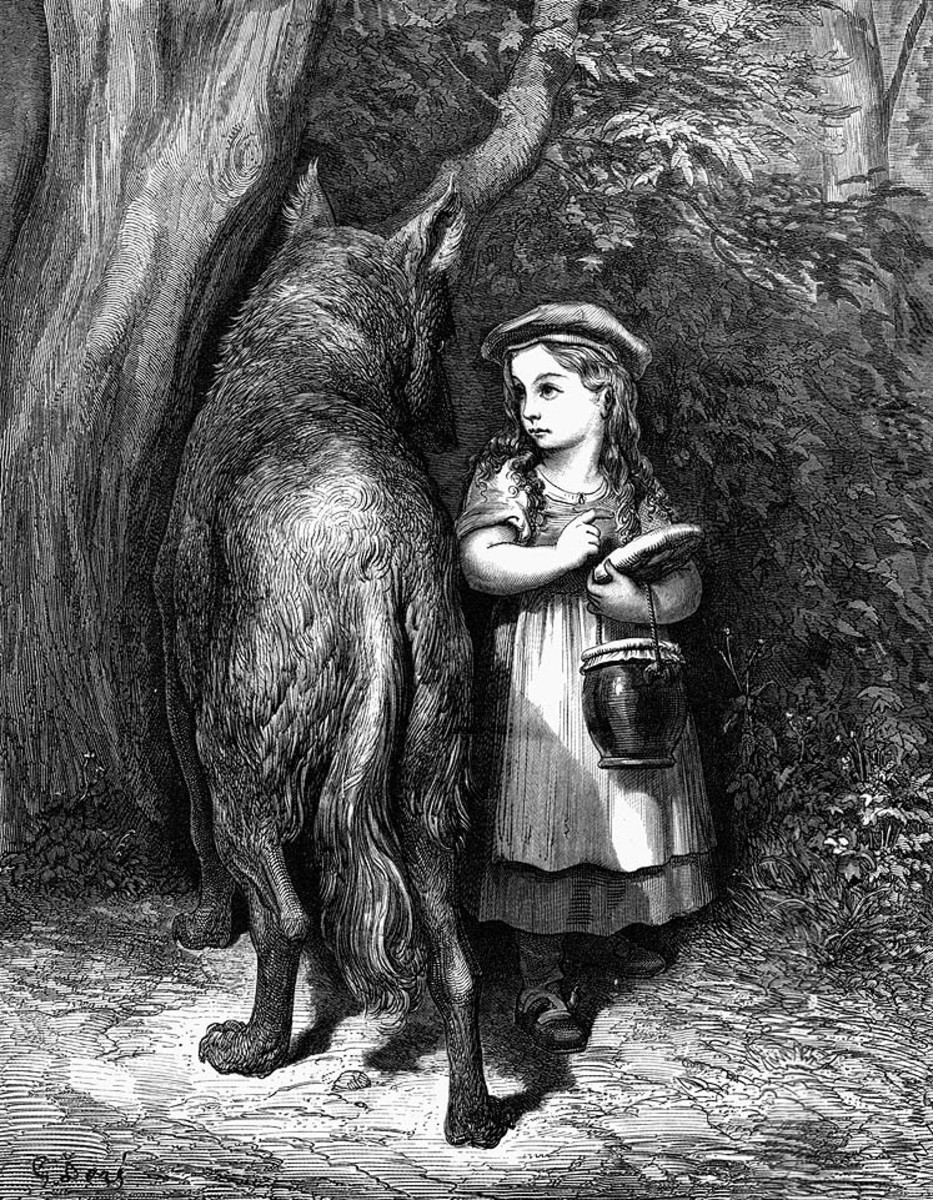
Recall the story of Little Red Riding Hood.
1. In which country do you imagine the story takes place?
How long ago?
2. Who are the characters?
3. What happens at each stage of the story?
4. Are there some folk tales from your own country set in
the forest?
5. Do you have stories about werewolves or people who can
change into monsters?
Excerpt from Revolting Rhymes by Roald Dahl
As soon as Wolf began to feel
That he would like a decent meal,
He went and knocked on Grandma's door.
When Grandma opened it, she saw
The sharp white teeth, the horrid grin,
And Wolfie said, "May I come in?"
Poor Grandmamma was terrified,
"He's going to eat me up!" she cried.
And she was absolutely right.
He ate her up in one big bite.
But Grandmamma was small and tough,
And Wolfie wailed, "That's not enough!
I haven't yet begun to feel
That I have had a decent meal!"
He ran around the kitchen yelping,
"I've got to have a second helping!"
Then added with a frightful leer,
"I'm therefore going to wait right here
Till Little Miss Red Riding Hood
Comes home from walking in the wood."
He quickly put on Grandma's clothes,
(Of course he hadn't eaten those).
He dressed himself in coat and hat.
He put on shoes, and after that
He even brushed and curled his hair,
Then sat himself in Grandma's chair.
In came the little girl in red.
She stopped. She stared. And then she said,
"What great big ears you have, Grandma."
"All the better to hear you with," the Wolf replied.
"What great big eyes you have, Grandma."
said Little Red Riding Hood.
"All the better to see you with," the Wolf replied.
He sat there watching her and smiled.
He thought, I'm going to eat this child.
Compared with her old Grandmamma
She's going to taste like caviar.
Then Little Red Riding Hood said, "But Grandma,
what a lovely great big furry coat you have on."
"That's wrong!" cried Wolf. "Have you forgot
To tell me what BIG TEETH I've got?
Ah well, no matter what you say,
I'm going to eat you anyway."
The small girl smiles. One eyelid flickers.
She whips a pistol from her knickers.
She aims it at the creature's head
And bang bang bang, she shoots him dead.
A few weeks later, in the wood,
I came across Miss Riding Hood.
But what a change! No cloak of red,
No silly hood upon her head.
She said, "Hello, and do please note
My lovely furry wolfskin coat."
Style
Summary
Summary
on in about off point because all rush be falls wart out spore
forest with paw into way live death
The narrator of "The Werewolf" sets the story's ominous tone 1____ the
opening sentence: "It is a northern country; they have cold weather; they
have cold hearts." The people in this country are poor and 2____ short,
hard lives. They are superstitious to the 3____ of conducting
witch-hunts and stoning any witches found (identified by a telltale third
nipple) to 4____. We focus in 5__ a young girl. Her mother sends her into the
forest to bring food to her ill grandmother, arming her with a
knife and warning her 6______ the dangers of the woods. The girl sets 7___ on
her journey unafraid 8____ she knows the forest well.
As she is walking, the girl hears a wolf's cry. She turns with her knife drawn to
face the beast, and when it lunges, she cuts off its 9___. It retreats back 10___
the forest. She wraps the wolf's paw in cloth and continues on her 11____. When
the girl reaches her grandmother's house, the snow is so thick that no 12_____
can be seen in it. She finds her grandmother in bed with a terrible fever, and
when shakes out the cloth to make a hot compress, the wolf's paw 13____
on the floor. It has changed into a hand, which she recognizes as her
grandmother's because of a single 14____ on it.
The girl uses 15____ her strength to pull back her grandmother's covers and
beneath them discovers the cause of her fever. Her grandmother's severed arm
is already rotting. Hearing the girl's cries, the neighbors 16____ in. They
examine the hand and declare the wart on it to 17___ "a witch's
nipple." They force the grandmother 18___ of bed and to the edge of the 19_____,
where they stone her to death. The story ends 20___ the summary,
"Now the child lived in her grandmother's house; she prospered."
Analysis
Because
Although
Perhaps
In this story
If
At the story's
end,
Therefore
By
1_________, Carter combines the characters of wolf and
grandmother to create a werewolf. In doing so, she suggests that man is not
woman's only enemy. Woman collude in and also plot other
women's destruction. The grandmother fears that the younger, more beautiful
girl will supplant her. The girl in "The Werewolf"
changes from hunted into huntress when she first cuts off the werewolf's paw
and then helps the neighbors kill her. 2_________ she helped kill her
grandmother in self-defense, the girl perpetuates the idea that women must be
rivals and try to destroy one another. She shows no remorse for
helping kill her grandmother, but rather "prospers" in her very
house.
This story maintains that knowledge is a woman's key to survival against
those that mean to harm and consume her. The heroine's knowledge consists of
inherited superstitions and time-worn warnings about the various forms of the
devil. She lives in a region where people believe in supernatural predators
and are jaded by violence even as children. 3________ the
girl is no helpless child as we know Red Riding Hood to be; she "a
mountaineer's child," accustomed to walking in wolf-and bear-infested
woods and to carrying and using a knife. Whereas in traditional versions of Red
Riding Hood, the reader is made to empathize with the
defenseless heroine, here the narrator separates us from her. The
narrator treats the heroine and the other people in her region with the bemused curiosity
of a naturalist, explaining, "to these upland woodsmen, the
Devil is as real as you or I."
4________ we are not made to definitely trust or pity the heroine, we do not
necessarily have to hate the werewolf. Indeed, we can pity the werewolf as
being a lonely and tormented half-creature who does not have
enough self-control to refrain from preying on her
own granddaughter.
5_________ we do not know whether to valorize or rebuke the
heroine for her actions. After all, she becomes as ferocious as
the werewolf in first cutting off her hand and then helping stone her to death.
She may even have turned into a witch herself, for how else could she prosper
in a region where people die early from the poverty and cold. 6_________
"the devil" in whatever form - witch, vampire, werewolf - is only the
institutionalized projection of our fears and desires. We fear
our own potential for wrongdoing, so we create fairy-tale monsters as external
projections of it. 7_________ evil exists outside ourselves, then it
cannot exist within ourselves. The villagers and the heroine in "The
Werewolf" subscribe to this "scapegoating" by hunting and
killing witches. Carter implicates not only them but us, the reader, as being
violent. 8_________ uprooting the traditional fairy-tale
perceptions of right and wrong, Carter makes the story resemble real life more
than allegory; she forces us to criticize not just the werewolf but
also the townspeople and to question whether we subscribe to similar delusions of
moral clarity.
What do the words in bold mean?
The narrator of "The Werewolf" sets the story's ominous tone with the opening sentence: "It is a northern country; they have cold weather; they have cold hearts." The people in this country are poor and live short, hard lives. They are superstitious to the point of conducting witch-hunts and stoning any witches found (identified by a telltale third nipple) to death. We focus in on a young girl. Her mother sends her into the forest to bring food to her ill grandmother, arming her with a knife and warning her against the dangers of the woods. The girl sets off on her journey unafraid because she knows the forest well.
As she is walking, the girl hears a wolf's cry. She turns with her knife drawn to face the beast, and when it lunges, she cuts off its paw. It retreats back into the forest. She wraps the wolf's paw in cloth and continues on her way. When the girl reaches her grandmother's house, the snow is so thick that no tracks can be seen in it. She finds her grandmother in bed with a terrible fever, and when shakes out the cloth to make a hot compress, the wolf's paw falls on the floor. It has changed into a hand, which she recognizes as her grandmother's because of a single wart on it.
The girl uses all her strength to pull back her grandmother's covers and beneath them discovers the cause of her fever. Her grandmother's severed arm is already rotting. Hearing the girl's cries, the neighbors rush in. They examine the hand and declare the wart on it to be "a witch's nipple." They force the grandmother out of bed and to the edge of the forest, where they stone her to death. The story ends with the summary, "Now the child lived in her grandmother's house; she prospered."
Little Red Riding Hood
Oh yeah and then there's this:
Here's Johnny

No comments:
Post a Comment