
What colour do you think of?
Sensitive
Earthy and serious
Neutral
Passionate
Creative and natural
Serious and professional
Practical and on the move
Open and positive
Helpful and kind
Creative and nerdy
Pure and innocent
Confident and passionate
Independent and a bit rebellious
Fun and sporty
Why?


1. What overall trends do you notice in car colour
popularity over time?
2. Around which years
do grey, black, and white cars start to dominate?
3. Which colour shows the fastest growth, and which declines
the most?
4. Are there any surprising changes or spikes in the data?
5. What do you think explains these choices? Do you think
practicality (e.g., resale value, maintenance) has anything to do with it?
6. What
colour is your car, and why did you choose it?
embarrassing sadness positive kindness innocent powerful love deep alon


Think of six things that are naturally blue. You can't say "sky"or "sea".


colour idioms
What colour goes with these noun-adjectives for colour?
ocean
Speaking:
You have ten characters in a play. They're personality and attitude is expressed in the following statements. What colour will their costume be?
1. Andy: I'm positive, open and lively.
2. Anna: I need my own space. I'm gentle but fragile.
3. Sharon: Don't tell me what to do. I'm my own boss.
4. Gus: I hear what you're saying but I don't want to be involved. I'm not really interested in people.
5. Brian: I'm a person in authority. Behave yourselves.
6. Patricia: I'm royalty. Obey me!
7. Angela: I'm caring and warm. Others are more important for me.
8. Susan: I'm creative yet analytical. I'm nerdy, but original.
9. Arthur: I'm passionate. Love me!
10. David: I'm often in a bit of a hurry, I hate to stand around all day. Please let me through.
Here are ten colours / shades:
1. Dark blue
2. Light blue
3. Orange
4. Red
5. Yellow
6. Grey
7. White
8. Purple
9. Peach
10. Black
Watch:
The mystery of Blue
Questions:
1. Which famous book about the sea never mentions the colour blue?
2. Which colours would be the first (and last) to be named in ancient
languages? Why?
red turquoise black blue white yellow green orange violet
3. Which culture was one of the first to produce a blue dye?
4. How could you test whether or not someone can see a colour?
5. "Without a word for a colour you may find it
difficult to see it”. Do you think this is true?
Discussion:
According to the video, is there some connection between a culture manufacturing colour and "naming" it?
What example was given of this?
Does Davidoff's test prove that having a word for a colour might help us to see it?
We use the expressions "eye-opening experience" or "to open someone's eyes" to mean a person or film or book or journey etc that really made you to see a whole new world.
Create the correct FORM of the word and then check below:
In 'The Odyssey,' Greek poet Homer FAME describes the 'wine-dark sea.'
Check
In 'The Odyssey,' Greek poet Homer famously describes the 'wine-dark sea.'
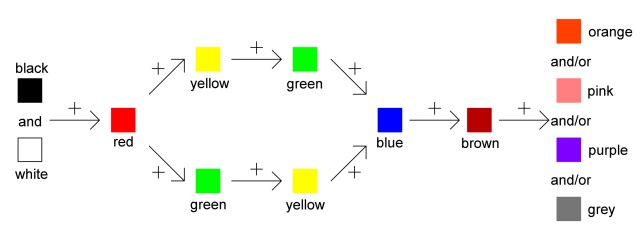
Look at this diagram. What do you think it illustrates?
The surprising pattern behind color names around the world
1. How many colour categories do we have in English?
2. How did anthropologists used to believe colour terms were chosen by cultures?
3. What did the research in 1969 suggest about how colour terms develop in a language?
4. What did William Gladstone notice about Homer's use of colour terms?
4. How do languages with only a few colour terms describe colours that don't have terms?
5. How is colour expressed in Hanuno'o?
6. Why might a word for "red" be formulated before a word for "blue"?
7. What have researchers discovered about colours themselves?

Where would you place these colours in the Hanuno'o spectrum?
Black, dark blue, light blue, purple, orange, white, grey, silver, gold, light green, dark green, pink, red, yellow....

No comments:
Post a Comment